 New


Cadastral value in Spain: how to find yours, and why it moves
The cadastral value in Spain, the valor catastral, is the figure your town's IBI and the Modelo 210 of a home you don't rent out are worked out from. Here is what it is, where yours is printed, how to look it up from abroad, and why it changes from one year to the next.
By the CasitaTax team · Updated November 18, 2026 · 8 min read
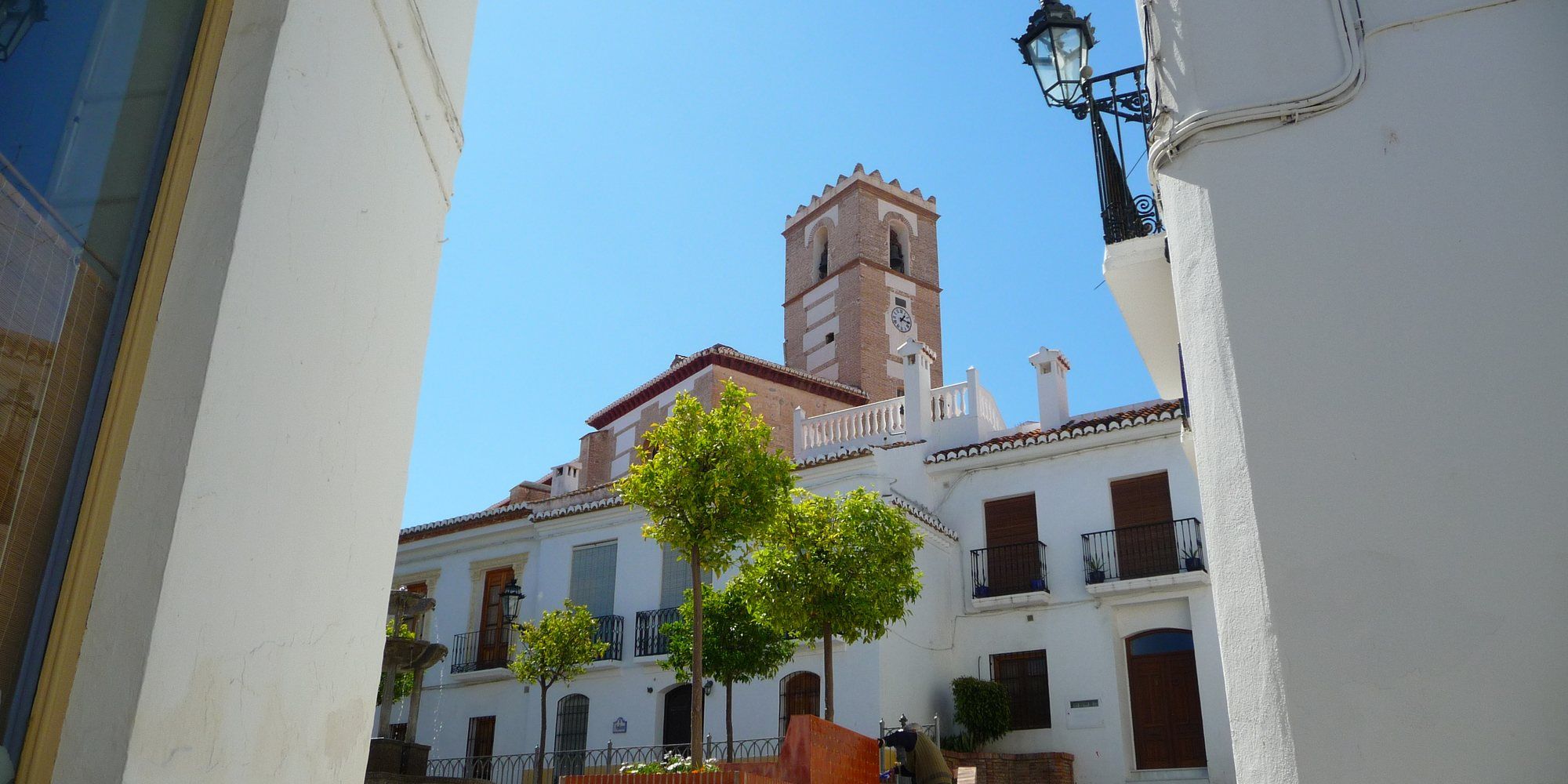
In short
 The valor catastral is the value the Catastro, Spain's property register, gives your home: the value of its land plus that of its building.
- It is set below the market price, and it is protected: only you, and the few others the law lists, may see it.
- It is printed on your IBI bill; online, the Sede Electrónica del Catastro shows it once you log in with Cl@ve or a digital certificate.
- It changes with a new valuation of your town, works on the home, or an update coefficient of the State budget (the last were set for 2020).
On this page
What is the cadastral value of a Spanish home?
It is the value the Catastro, the property register of Spain's Ministry of Finance, gives each property from the data it holds: the value of the land plus the value of the building on it (art. 22 of the Catastro law). In Spanish, the valor catastral.
The Catastro sets it, not your town hall nor the Land Registry. The town bills the IBI on it and can ask the Catastro to revalue its homes, but the figure is the Catastro's.
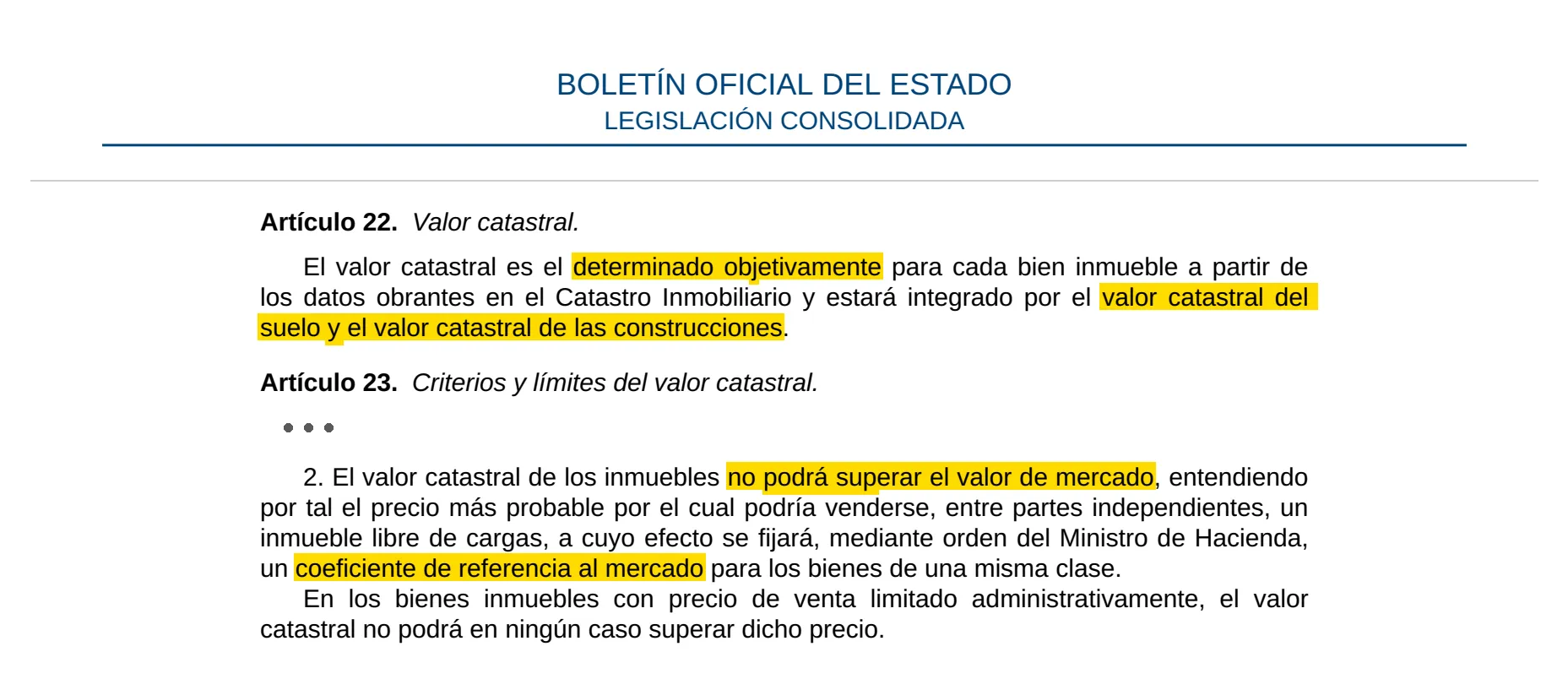
The two parts matter separately: the land's value is the one the town's tax on a sale, the plusvalía municipal, is worked out from. Both are protected data the owner can consult, like the total.
Is the cadastral value the market value?
No, it is lower by design. The law says it may never exceed the market value, and has a reference-to-market coefficient set for each class of property (art. 23.2): for homes and other urban property, a ministerial order of 1998 sets the values at about 50% of the market value when a whole town is revalued.
That share only holds on the day of the valuation. Prices move every year, while the cadastral value moves only with a new valuation or an update coefficient, so the gap can grow or shrink. In most towns, the values come from a general valuation more than 10 years old.
Two other figures are often confused with it. The valor de referencia, which the Catastro works out from the prices of notarised sales, is the base of the transfer tax on a resale and of inheritance and gift tax, not of the IBI. A bank's appraisal (tasación) is a private valuation for a mortgage.
Where do you find your cadastral value?
On papers you already have, or from the Catastro:
- The IBI bill (recibo del IBI), the town's yearly property tax: it is the tax's base, and the rules on IBI bills require it to be printed there, with the referencia catastral. The Agencia Tributaria itself tells owners to take the value on the IBI bill.
- A Catastro certificate (certificación catastral), free when you download it from the Catastro's website, logged in as the owner.
- A Punto de Información Catastral, often at the town hall, or a Gerencia del Catastro, on showing your ID. Only the Sede is free: a Gerencia charges the Catastro's fee for a paper certificate, and the body running a PIC may charge one.
Unlike the cadastral reference number, which anyone can look up from the address, the value is protected data (art. 51 of the Catastro law). Only the owner may see it, and, under art. 53, a few others: their heirs, a tenant or the holder of a usufruct, notaries and registrars, public administrations and courts, or anyone with the owner's written consent, such as your accountant. A neighbour or a buyer can't, without your consent.
In the País Vasco and Navarra, the regions keep their own cadastres: look the value up there; our Catastro page lists where. The rest of this page doesn't apply there.
How do you look up your cadastral value online?
On the Catastro's website, as the owner:
- 1Open the Sede Electrónica del Catastro: it has an English version, partly translated.
- 2If you have Cl@ve or a digital certificate, log in with it. Or use the Catastro's own clave concertada: the Sede asks for your NIE number, the support number (IXESP) printed on an NIE card, your name and the referencia catastral of one of your homes. An NIE on paper, without a card, has no IXESP.
- 3Look up your property among those in your name: the Sede shows its valor catastral and gives you a free certificate.
No Cl@ve or certificate? The IBI bill is the simplest; otherwise a Punto de Información Catastral or a Gerencia gives you the value on showing your ID, and a person with your written consent can ask for it.
Only know the IBI you paid? Our valor catastral calculator estimates the value from it and your town's IBI rate, as a range. It is an estimate: the bill or the Sede gives the exact figure.
How is the cadastral value worked out?
Town by town. The Catastro draws up a ponencia de valores for the town: values per street or zone for land, and building costs by use, quality and age (arts. 23 to 27). Each home's value follows from it and from what the Catastro knows of the home: its plot, its floor area, its use, its year of building.
A general valuation applies a new ponencia to the whole town. It comes at least 5 years after the last one, and the law expects one once 10 years have passed (art. 28.3); many towns wait much longer. Each owner is then notified their new value, which takes effect on January 1 of the following year (art. 29.5).
The year of your town's last general valuation is public: our Catastro page shows it on your home's card. Under the rules for 2026, it also decides the percentage of your tax on an empty home in Spain.
Why did your cadastral value change?
Four things move it:
- A general valuation of your town: every home gets a new value, notified one by one, from January 1 of the next year.
- An update coefficient: the State's budget law can raise or lower the values of a town that asked for it, by a coefficient that depends on the year of its last valuation (art. 32.2). The last ones were set for 2020; none since.
- Works on the home: an extension, a pool, a new floor or a change of use is declared to the Catastro, which values the home again; the new value counts from the date of the works, whenever it is notified (arts. 13 and 17.6).
- A partial or simplified valuation, for part of a town or after a change in its planning.
A value notified after a valuation can be contested within 1 month of its notification, before the Catastro or the economic-administrative tribunal; contesting does not suspend it (art. 29.6–7).
A higher value raises the IBI and the Modelo 210 of a home you don't rent out. After a general valuation, the IBI softens the rise: its base climbs to the new value over 9 years. The Modelo 210 has no such reduction: it takes the new value at once, but under the rules for 2026 at 1.1% instead of 2%, since the town's values are now recent, as the Modelo 210 form in English shows.
What is the cadastral value used for?
The taxes an owner abroad meets, and the value each starts from:
IBI, the town's property tax
- When
- Every year
- What it is worked out from
- The valor catastral, less a reduction in the years after a general valuation
Modelo 210, home not rented out
- When
- Every year
- What it is worked out from
- 1.1% or 2% of the valor catastral, depending on the town's last valuation (rules for 2026)
Plusvalía municipal
- When
- When you sell, give or leave the home
- What it is worked out from
- The land's cadastral value, or the real gain if lower; nothing without a gain
Wealth tax
- When
- On a large estate
- What it is worked out from
- The highest of the valor catastral, a value the administration set for another tax, and the price you paid
Transfer tax on a resale purchase; inheritance and gift tax
- When
- When the home changes hands
- What it is worked out from
- Not the valor catastral: the valor de referencia, unless the price or declared value is higher
| Tax | When | What it is worked out from |
|---|---|---|
| IBI, the town's property tax | Every year | The valor catastral, less a reduction in the years after a general valuation |
| Modelo 210, home not rented out | Every year | 1.1% or 2% of the valor catastral, depending on the town's last valuation (rules for 2026) |
| Plusvalía municipal | When you sell, give or leave the home | The land's cadastral value, or the real gain if lower; nothing without a gain |
| Wealth tax | On a large estate | The highest of the valor catastral, a value the administration set for another tax, and the price you paid |
| Transfer tax on a resale purchase; inheritance and gift tax | When the home changes hands | Not the valor catastral: the valor de referencia, unless the price or declared value is higher |
To see what yours means in tax, our non-resident tax in Spain simulator works out the Modelo 210 of the home from its cadastral value, and the capital gains tax in Spain simulator the plusvalía from the land's value.
If you'd rather not file the Modelo 210 yourself, we file it for you from your latest IBI bill, which carries the cadastral value.
We file your Modelo 210
 Every owner, every year
- You approve before we file
- 100% online
What if your home has no cadastral value yet?
It happens with a new build the Catastro hasn't valued yet. Once the building is declared, the Catastro values it under the town's ponencia, and the value counts from the date of the works.
Meanwhile, the Modelo 210 of a home you don't rent out is worked out on another base, 50% of the higher of the price you paid and the value the administration checked for another tax: see the tax on an empty home in Spain. The IBI then applies the value from the January 1 after the works, so the town can bill the earlier years still open too.
How we checked this guide
We read the official texts below and update this guide whenever the rules change. It is general information, not advice on your own situation.
- Real Decreto Legislativo 1/2004, texto refundido de la Ley del Catastro Inmobiliario (arts. 1, 13, 17, 22–32, 51–53, 62 y disposición final tercera) — read on November 18, 2026
- Real Decreto Legislativo 2/2004, Ley Reguladora de las Haciendas Locales (arts. 65–68, 75 y 104–107) — read on November 18, 2026
- Ley 19/1991, del Impuesto sobre el Patrimonio (art. 10) — read on November 18, 2026
- Orden de 14 de octubre de 1998, coeficiente de relación al mercado — read on November 18, 2026
- Real Decreto 417/2006, Reglamento del Catastro Inmobiliario (art. 70) — read on November 18, 2026
- Ley 35/2006, del IRPF (art. 85) — read on November 18, 2026
- Real Decreto Legislativo 1/1993, ITPAJD (art. 10), y Ley 29/1987, del Impuesto sobre Sucesiones y Donaciones (art. 9) — read on November 18, 2026
- Dirección General del Catastro, Sede Electrónica del Catastro — read on November 18, 2026
- Dirección General del Catastro, Punto de Información Catastral — read on November 18, 2026


