 New


Cadastral reference number: where to find it, and what it says
Your Spanish home's cadastral reference number, the referencia catastral, is asked for by the tax office, notaries and the electricity company. It is already printed on papers you have: here is where, how to look it up from the address, and how to read it.
By the CasitaTax team · Updated November 13, 2026 · 8 min read
In short
 The cadastral reference number (referencia catastral) is the Catastro's ID of one property: 20 letters and digits.
- It is printed on the IBI bill, and usually on your title deed and the nota simple; anyone can look it up from the address.
- Each flat, and each garage or storeroom that is a property of its own, has its own reference; the first 14 characters are the parcel's, shared by the whole building.
- Modelo 210 asks for it in box 60, on every return about the home.
On this page
What is a cadastral reference number in Spain?
It is the code the Catastro, the property register of Spain's Ministry of Finance, gives each property: 20 letters and digits, called the referencia catastral in Spanish. The Catastro gives each property a single reference, which places it on its official map (art. 6.3 of the Catastro law).
The law wants it on every document about the home with an economic or tax side: the deed, a lease, the electricity contract, a tax return. That is why so many people ask you for it, and why Modelo 210, the return of a non-resident owner, has a box for it.
It is not the home's value: the valor catastral, the value the Catastro gives the home, is another figure, usually printed on the same IBI bill.
Where do you find your cadastral reference number?
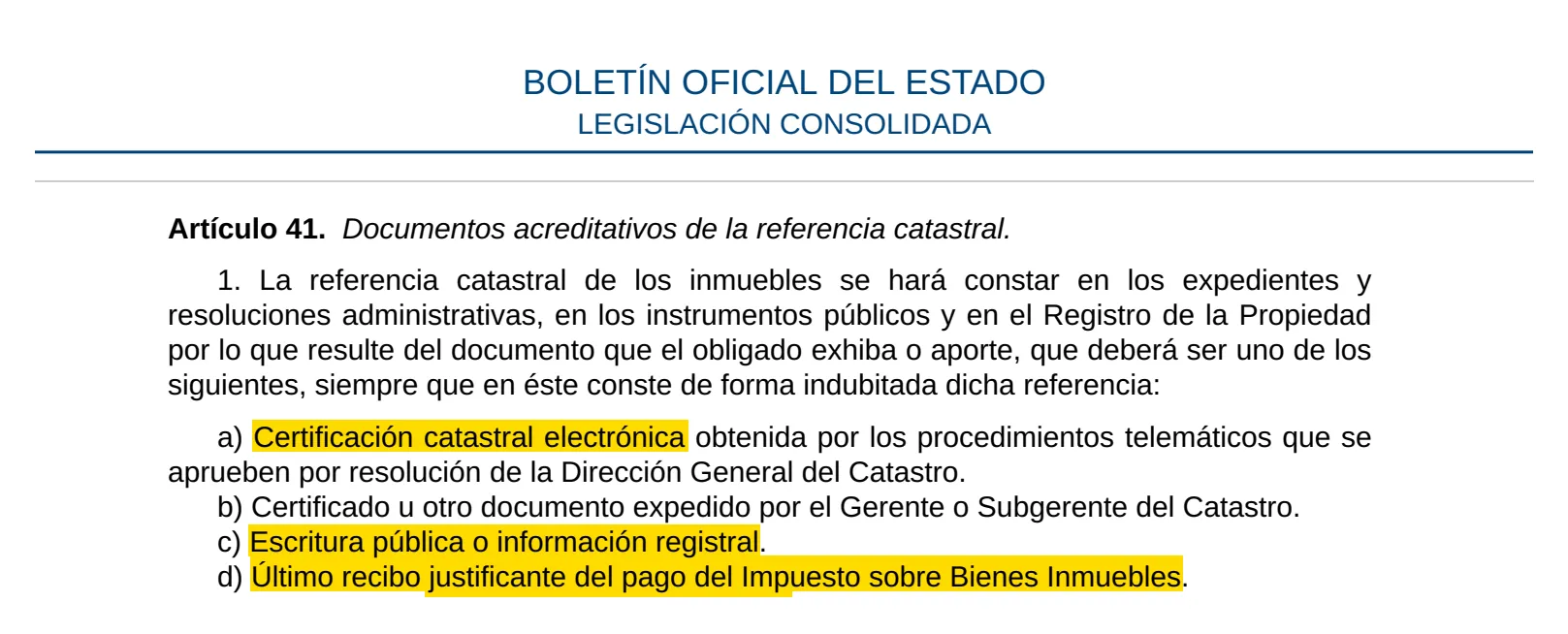
On papers you already have. The law lists the documents that prove a property's reference (art. 41 of the Catastro law), and three of them are probably in your files:
- The IBI bill (recibo del IBI), the town's yearly property tax: the latest one shows the reference with the property's other cadastral data. It is the quickest place to look.
- Your title deed (escritura): the notary copies the reference into the deed of a sale, a gift or an inheritance. A deed without it is still valid; the notary notes in it that the reference is missing.
- The nota simple of the Land Registry (Registro de la Propiedad): the Registry's entry records the reference when the Registry holds it, which is usually, not always, the case.
- A Catastro certificate (certificación catastral), free when you download it from the Catastro's website.
Two other papers usually carry it: the lease, if you rent the home out, since the landlord must state it, and the electricity contract, since the law requires it in electricity supply contracts (art. 38).
The same IBI bill usually shows the valor catastral too, the figure you need to estimate your non-resident tax in Spain.
How do you find the cadastral reference number from the address?
Look it up in the Catastro: the reference is public, so anyone can find a home's reference from its address, without logging in (art. 52 of the Catastro law). Only the owners' identity and address and the valor catastral are protected.
- 1Type the province, town, street and number on our Catastro page to find your referencia catastral: it asks the Catastro's free web services and shows the home's reference, use, built area and year built. The Buscador de inmuebles of the Sede Electrónica del Catastro, offered in English, does the same.
- 2In a building, pick your staircase, floor and door from the list: each flat has its own reference.
- 3Nothing found? Type the street's name as the Catastro writes it, often in Spanish or the regional language, without its type ("Mayor" rather than "Calle Mayor").
Neither works? A Punto de Información Catastral, run by a public body such as a town hall, or a Gerencia del Catastro gives you the reference (Catastro).
What do the 20 characters of a cadastral reference mean?
They say where the property is, from the parcel down to the unit. The Catastro's own example of a reference in a town is 9872023 VH5797S 0001 WX:
1 to 7
- In the example
- 9872023
- What they identify
- The parcel (finca or parcela)
8 to 14
- In the example
- VH5797S
- What they identify
- The sheet of the Catastro's map the parcel lies on
15 to 18
- In the example
- 0001
- What they identify
- The property within the parcel: a flat, a garage, a shop
19 and 20
- In the example
- WX
- What they identify
- Two control characters, worked out from the 18 before them to catch typos
| Characters | In the example | What they identify |
|---|---|---|
| 1 to 7 | 9872023 | The parcel (finca or parcela) |
| 8 to 14 | VH5797S | The sheet of the Catastro's map the parcel lies on |
| 15 to 18 | 0001 | The property within the parcel: a flat, a garage, a shop |
| 19 and 20 | WX | Two control characters, worked out from the 18 before them to catch typos |
A rural property (rústica) reads differently: the province (2 digits), the town (3), a sector letter, the polígono (3), the parcela (5), the property (4) and the two control characters. The Catastro's example: 13 077 A 018 00039 0000 FP.
The control characters catch most typos: our Catastro page checks them and tells you when a reference you copied doesn't add up.
Do a flat, its garage and its storeroom share one reference?
Not necessarily. Each flat has its own: all the flats of a building share the first 14 characters, those of the parcel, and differ in the next four (0001, 0002…). A garage space or a storeroom that is a property of its own in the Catastro has its own reference too; one bought with the flat as a single unit can share the flat's (art. 6.2 of the Catastro law).
Watch out
A reference of 14 characters points to the whole parcel, not to your home. When a form asks for the referencia catastral, give all 20 characters of your own property, never the building's or a neighbour's.
When will you be asked for your cadastral reference number?
Whenever a document concerns the home. Those an owner abroad meets:
- Modelo 210: box 60 takes it on every return about the home, as our guide to the Modelo 210 form in English shows; from 2027, a new box 61 also asks whether the home has one.
- Selling or giving the home: the notary copies it into the deed; seller and buyer are both bound to provide it, and one of them doing so is enough.
- Renting it out: the landlord states it in the lease.
- Electricity: the supply contract carries it.
If you'd rather not fill in the Modelo 210 yourself, we file it for you from your NIE and your latest IBI bill, which carries the reference.
We file your Modelo 210
 Every owner, every year
- You approve before we file
- 100% online
What if your home has no cadastral reference number?
It happens with a new build the Catastro doesn't list yet. For flats still being built, the notary asks the Catastro for a provisional reference when the deed that divides the building into flats is signed (art. 47.2 of the Catastro law).
Nobody is blamed for a reference that doesn't exist: the law clears owners when it doesn't exist or can't be found in the documents above or on the Catastro's website (art. 70).
On the Modelo 210 form used from 2027, box 61 says so: 1 for a home with a referencia catastral, 2 for a home without one.
A reference can also change when a property is divided, joined to another or split into flats: the latest IBI bill or the Catastro gives the current one.
Is the cadastral reference the same as the valor catastral or the land registry number?
No. Three things often get mixed up:
- Referencia catastral: the Catastro's ID of the property. Public.
- Valor catastral: the value the Catastro gives the property. Protected: only the owner and the few others the law lists may see it. It is the base of the IBI and of the tax on a home you don't rent out, explained in our guide to the tax on empty home in Spain.
- Finca registral and Código Registral Único: the numbers of the Land Registry, another register, kept by registrars, which records who owns the home. The Registry's entry also states the referencia catastral.
The IBI, one of the property taxes in Spain for non residents, and the Modelo 210 of a home you don't rent out are worked out from the valor catastral; the reference only says which property they are about.
How do you get a certificate of your cadastral reference?
Online, for free: certificates obtained directly from the Sede Electrónica del Catastro carry no fee, while those a Gerencia del Catastro issues on request do (art. 62 of the Catastro law).
To see protected data such as the valor catastral, you log in to the Sede as the owner, with Cl@ve or a digital certificate; our Catastro page explains how.
A Punto de Información Catastral can also certify the reference, and give the owner their protected data on showing an ID document.
What if the home is in the País Vasco or Navarra?
Look in the region's own cadastre. Álava, Bizkaia, Gipuzkoa and Navarra keep their own, outside the Dirección General del Catastro (art. 1.2 of the Catastro law): look your home up there; our Catastro page lists where.
How we checked this guide
We read the official texts below and update this guide whenever the rules change. It is general information, not advice on your own situation.
- Real Decreto Legislativo 1/2004, texto refundido de la Ley del Catastro Inmobiliario (arts. 1, 6, 38–48, 51–53, 62 y 70) — read on November 13, 2026
- Dirección General del Catastro, La referencia catastral — read on November 13, 2026
- Dirección General del Catastro, Punto de Información Catastral — read on November 13, 2026
- Real Decreto Legislativo 2/2004, Ley Reguladora de las Haciendas Locales (art. 77) — read on November 13, 2026
- Ley Hipotecaria (art. 9) — read on November 13, 2026
- Orden HAC/623/2026, nuevo modelo 210 (casilla 61) — read on November 13, 2026


