 New


Modelo 210 previous years: how far back, and how to catch up
Modelo 210 previous years can still be filed: the tax office has 4 years from the end of each return's window to claim it, so today, for a home not rented out, the tax years 2021 to 2025 are open. Here is how the limit works, which rules each year takes, and how to catch up.
By the CasitaTax team · Updated November 9, 2026 · 8 min read
In short
 4 years from the end of each window, not from the tax year: for a home not rented out, 2021 to 2025 are open today.
- The count starts again when the tax office acts on a return, or when you do.
- One return per year and per owner, each with that year's rules, not this year's.
- Filed before any letter, a past year costs a surcharge, not a penalty.
- A year that has prescribed isn't filed: if it was paid anyway, the payment can be asked back.
On this page
Which Modelo 210 years do you have to catch up on?
Every tax year you owned the home while living outside Spain, and that is still open: for a home not rented out, 2021 to 2025 today, as we read the law. A non-resident owes a Modelo 210 for each of those years, rented out or not (a tax resident of Spain declares on the Spanish income tax return instead); a home that isn't rented out pays on a notional income, a share of its cadastral value, worked out in our Modelo 210 form guide.
- Each owner files their own return: a couple who own the home half each file two returns per year.
- The year you bought or sold counts too, for the days you owned the home.
For the most recent years, mind which are already late. A return is late from the day after its window closes: our guide to the Modelo 210 deadline gives every window.
How many years back can Spain claim Modelo 210?
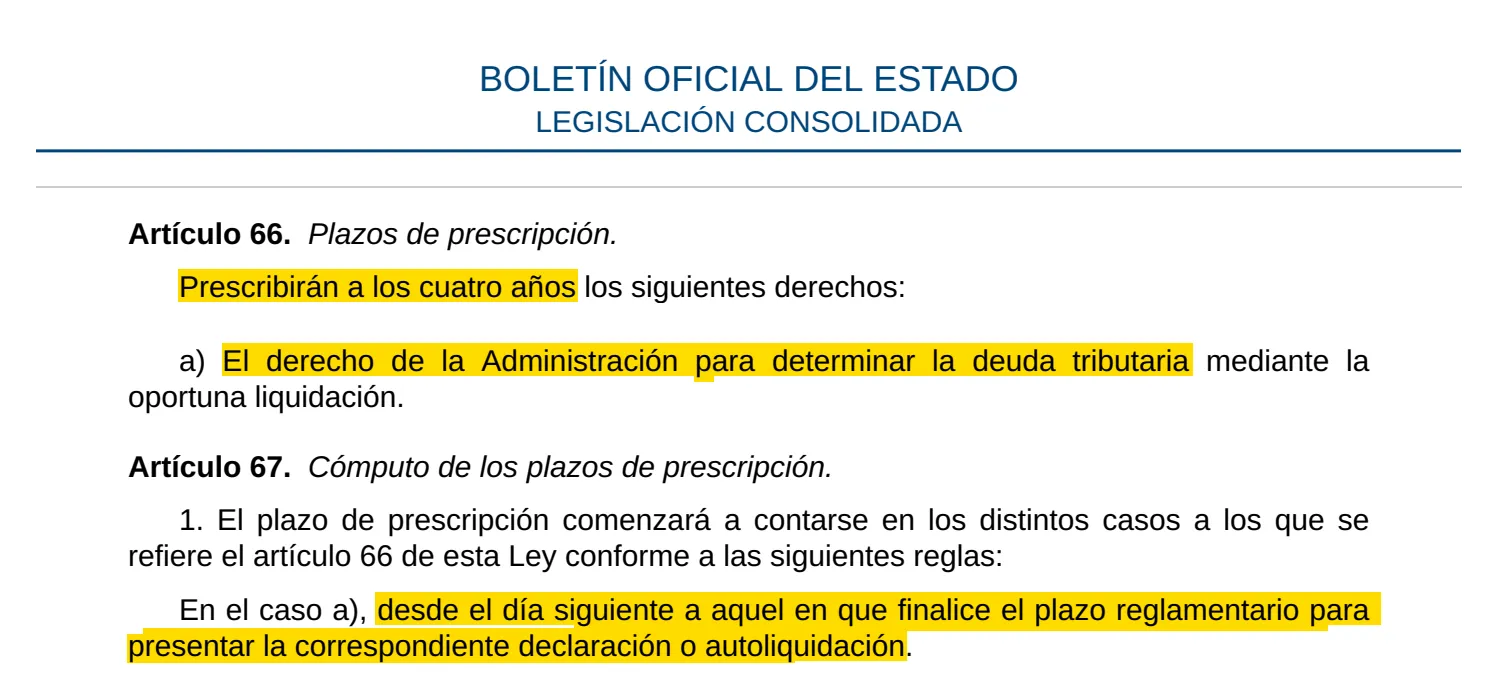
The limit is 4 years, counted from the day after the end of each return's filing window: that is Spain's statute of limitations for taxes, the prescripción of the Ley General Tributaria (arts. 66 and 67). The count runs per return, not per tax year.
Take the 2024 return of a home not rented out:
December 31, 2025
Last day of its window
From January 1, 2026
Late: the surcharge starts at 1%
From January 1, 2027
Surcharge of 15%, and interest starts
Until December 31, 2029
The tax office can still claim it, as we read the law, unless the count restarts
That is why people say five years: since the return of a home not rented out is filed the year after, 5 tax years are open at once. The oldest open today, 2021, stays open until December 31, 2026, as we read the law. The ten years some pages quote concern losses and credits carried forward, not a Modelo 210 never filed.
What restarts the four-year count?
Any step that the law treats as acting on the tax: the count stops, and 4 new years start from that day (art. 68).
- An action of the tax office that you are formally told of, aimed at checking or assessing the tax: a letter, a request for information, a check.
- The same, through another country: actions taken abroad under mutual assistance between tax authorities count too.
- An appeal or a claim of any kind.
- A step of yours towards filing or assessing that tax.
Does filing one year restart another? As we read the law, no: a return acts on its own year's tax, and each year has its own count. We found no official statement on this.
So waiting is a poor bet: a single letter starts the count again for what it concerns, and from then on that return no longer gets the surcharge: a penalty can apply instead. What a letter means, and the time it gives you: our page on tax office letters.
What about years that have prescribed?
You don't file them: prescription wipes out the tax debt, and the law applies it of its own accord, without your having to ask (art. 69). For a home not rented out, that means 2020 and the years before, as we read the law, unless the count restarted for one of them.
If a prescribed year was paid anyway, the payment is undue and can be asked back, within 4 years of paying it (arts. 66 and 221).
Which rules apply to each past year?
That year's, not this year's: each return is worked out on the rules, the value and the situation of its own tax year.
- The tax rate: 19% for residents of the EU, Iceland, Norway and Liechtenstein, 24% for everyone else, in every year open today. The United Kingdom is at 24%, since Brexit. As we read it, where you lived decides: on the last day of the year for a home not rented out, when the rent fell due for rent.
- The notional income on a home you don't rent out: 1.1% of the cadastral value where the town's values were revised recently enough, 2% otherwise. What counts as recent depends on the tax year.
- The cadastral value of that year, which can differ from today's: it is the taxable base of the IBI, so as we read it each year's IBI bill shows it, as the valor catastral (not the lower base liquidable).
- The days you owned it, and those it was rented out, which come off the notional income in proportion.
The past-years calculator applies each year's rates for a home that wasn't rented out. For this year's return, the non-resident tax in Spain simulator.
What if the home was rented out some years?
Then those years have rental returns, with windows of their own, plus a notional income for the days it wasn't rented. For rent with tax to pay, each quarter had its own return before 2024; from 2024 on, a year's rent can be grouped on one return.
Each rental return has its own 4 years, counted from the end of its own window: rent filed per quarter prescribes quarter by quarter, so the oldest open year of rent is not the oldest open year of a home left empty. Residents of the EU and the EEA deduct the expenses of the rented period; everyone else is taxed on the gross rent. Keep the contracts and the receipts of each year.
How do you catch up on several years of Modelo 210?
Year by year, each on its own return: the law doesn't let a late return cover more than one period (art. 27).
- 1List the open years you owned the home, for each owner, and which of them were rented out.
- 2Gather each year's figures: the cadastral value, the days owned and rented, where you lived, and the rent and expenses of rented years.
- 3Start with the most recent late year if it isn't yet twelve months late: its surcharge climbs one point a month, then jumps to 15% with interest. The older years are already at 15%, and their interest runs by the day: file them straight after. This order is our reading of the scale.
- 4Fill in each return on the tax office's online form, which covers tax years from 2019 on; returns filed from January 1, 2027 use the new form, whatever their year. Without Spanish online access, the Modelo 210 predeclaración, listed for tax years from 2019 on, covers past years too.
- 5Pay each one when you file it: direct debit isn't open after the window, but a transfer from abroad, a card or a Spanish bank are; see how to pay Modelo 210.
- 6Keep each proof of filing and payment, then watch for the letters about the surcharges.
We file your Modelo 210
 Every owner, every year
- You approve before we file
- 100% online
Catching up is what we do with Modelo 210: we work out each open year, for each owner, and file them with the current year's.
What does catching up on past years cost?
The tax of each year, plus a surcharge if you file before any letter from the tax office: 1% plus 1% per full month late, then 15% with interest after twelve months, a quarter less if you pay the tax when you file and the surcharge by its due date. Our guide to Modelo 210 late filing shows each stage, with a worked example.
After a letter, the surcharge is no longer available: you owe interest from the end of the window, and a penalty can follow, from 50% of the tax before reductions. A late return with nothing to pay has no surcharge, but the law provides a fixed fine. The tax office has a procedure of its own for non-residents who haven't filed.
What each open year comes to for your home: the past-years calculator, which adds the surcharge and the interest year by year.
Does unpaid Modelo 210 tax prescribe too?
Yes, on its own clock: if you filed a return on time but didn't pay it, the tax office has 4 years from the end of the payment period to collect it (arts. 66 to 68). The count starts again with any collection step you are told of, an appeal, or a step of yours towards paying.
Meanwhile, the unpaid tax goes into collection, with surcharges of its own: our late filing guide sets them out.
How we checked this guide
We read the official texts below and update this guide whenever the rules change. It is general information, not advice on your own situation.
- Ley 58/2003, General Tributaria (arts. 27, 66–69 y 221) — read on November 5, 2026
- Real Decreto Legislativo 5/2004, texto refundido de la Ley del IRNR (arts. 24 y 25) — read on November 5, 2026
- Ley 35/2006, del IRPF (art. 85, imputación de rentas inmobiliarias) — read on November 5, 2026
- Real Decreto Legislativo 2/2004, Ley Reguladora de las Haciendas Locales (art. 65) — read on November 5, 2026
- Orden EHA/3316/2010, modelos 210, 211 y 213 (texto consolidado) — read on October 29, 2026
- Orden HAC/623/2026, de 12 de junio (BOE-A-2026-13573) — read on November 3, 2026
- Agencia Tributaria, Modelo 210: instrucciones — read on November 5, 2026
- Agencia Tributaria, Modelo 210: gestiones — read on November 5, 2026
- Agencia Tributaria, Regularización por falta de presentación del IRNR — read on November 5, 2026


