 New


Property taxes in Spain for non residents: every tax on your home, through the year
Property taxes in Spain for non residents come from the town and from the State. Almost every owner owes two of them each year, the IBI and the non-resident income tax, even on a home that stays empty; the others come with what you do with it. Here is each one, who charges it, and when it is due.
By the CasitaTax team · Updated November 12, 2026 · 10 min read
In short
 Two taxes every year: the IBI, paid to the town, and the non-resident income tax, declared on Modelo 210, even if the home earns nothing.
- A waste fee too: the town charges it for collecting rubbish, usually to the owner.
- Renting out puts the rent on Modelo 210, taxed at 19% in the EU and the EEA, 24% elsewhere.
- Wealth tax only on a large estate in Spain (above €700,000 under the State's rules); a sale or an inheritance brings taxes of its own.
- Each has its calendar: the IBI falls on whoever owns the home on January 1; from tax year 2026, the return of a home not rented out is filed from April 1 to December 31 of the following year.
On this page
Which property taxes do non-residents pay in Spain?
Two every year, whatever you do with the home: the IBI, the town's property tax, and the non-resident income tax on the home, declared on Modelo 210. The town adds its waste fee. The other taxes only come with an event: renting it out, owning a large estate in Spain, selling, inheriting.
IBI
- Who charges it
- The town
- Who pays it
- Every owner
- When
- Each year, in a period the town sets
Non-resident income tax (Modelo 210)
- Who charges it
- The State
- Who pays it
- Every owner who is an individual
- When
- Each year, for the year before
Waste fee (tasa de basura)
- Who charges it
- The town
- Who pays it
- Usually the owner, for whoever lives there
- When
- As the town bills it
Tax on the rent (Modelo 210)
- Who charges it
- The State
- Who pays it
- Owners who rent out
- When
- The year after the rent
Wealth tax (Modelo 714)
- Who charges it
- The State, under its rules or a region's
- Who pays it
- Owners of a large estate in Spain
- When
- Each year, in a window set by order
Tax on the gain, and the plusvalía
- Who charges it
- The State; the town
- Who pays it
- Sellers (the buyer pays the plusvalía for a non-resident)
- When
- After the sale
Inheritance and gift tax
- Who charges it
- The State, under a region's rules
- Who pays it
- Heirs, and whoever receives a gift
- When
- After the death or the gift
| Tax | Who charges it | Who pays it | When |
|---|---|---|---|
| IBI | The town | Every owner | Each year, in a period the town sets |
| Non-resident income tax (Modelo 210) | The State | Every owner who is an individual | Each year, for the year before |
| Waste fee (tasa de basura) | The town | Usually the owner, for whoever lives there | As the town bills it |
| Tax on the rent (Modelo 210) | The State | Owners who rent out | The year after the rent |
| Wealth tax (Modelo 714) | The State, under its rules or a region's | Owners of a large estate in Spain | Each year, in a window set by order |
| Tax on the gain, and the plusvalía | The State; the town | Sellers (the buyer pays the plusvalía for a non-resident) | After the sale |
| Inheritance and gift tax | The State, under a region's rules | Heirs, and whoever receives a gift | After the death or the gift |
To see which of them your home owes this year, the Spanish property tax obligations tool asks a few questions and lists them, with their dates.
What is the IBI, and how much is it?
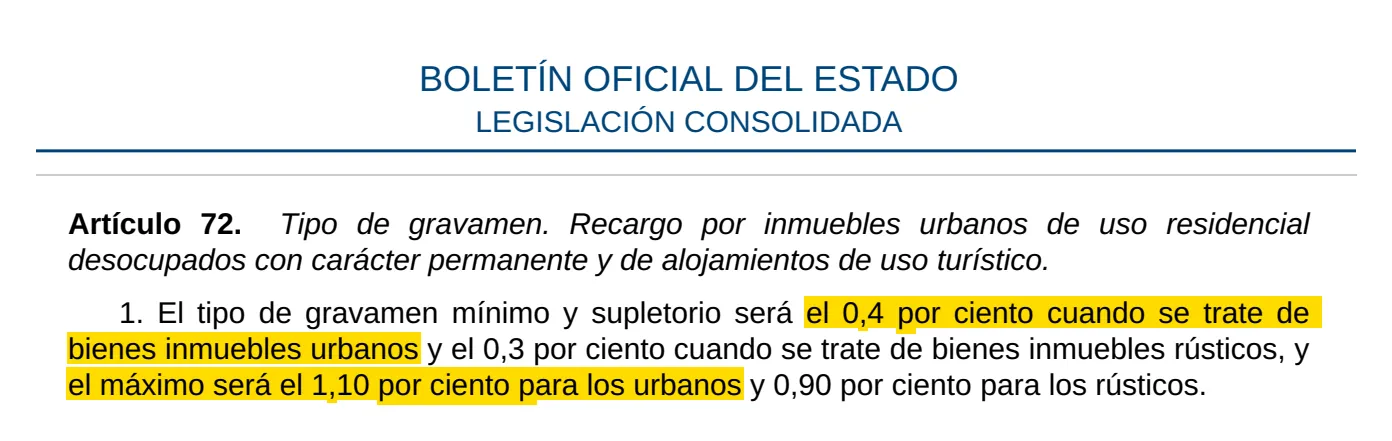
The IBI (Impuesto sobre Bienes Inmuebles) is the town's yearly tax on the home's cadastral value, the same for residents and non-residents. Each town sets its rate for urban property, normally between 0.4% and 1.1%. It can add up to 0.2 percentage points if it is a provincial or regional capital, runs public transport or offers more services than it must, or go as low as 0.1% for up to 6 years after a general revaluation. The rate applies to the taxable value on the bill: the cadastral value, less a reduction in the years after a revaluation. Towns may also exempt homes whose IBI would be very small.
The whole year's IBI falls on whoever owns the home on January 1. A sale deed can share it out between seller and buyer, but the town bills the owner of that day. The town, or the provincial body it has handed collection to, sets when it is paid, in a period of at least two months.
Paying the IBI doesn't settle the State's tax on the home, nor the reverse: they are two taxes, owed to two administrations. The IBI bill usually also shows the cadastral value that the State's tax is worked out from. Some towns surcharge the IBI of homes left empty for over two years, mainly those of owners of four or more homes; a second home counts as justified for up to four years. Our guide to the tax on empty home in Spain says when.
What is the yearly non-resident income tax on the home?
Spain taxes a notional income on a home its non-resident owner doesn't rent out, even when it stays empty. That income is 1.1% or 2% of the cadastral value, depending on the town, and the tax on it is 19% for residents of the EU, Iceland, Norway and Liechtenstein, 24% for everyone else, the United Kingdom included (rules for 2026). No expense comes off it.
Each owner files a Modelo 210 once a year per home. The 2025 return is due by December 31, 2026; from tax year 2026, the window runs from April 1 to December 31 of the following year. Our Modelo 210 deadline guide gives every date, and the one on Modelo 210 co-owners how a couple splits it.
For your own home, the non-resident tax in Spain simulator works out the sum. A year you missed can still be filed: see Modelo 210 previous years.
We file your Modelo 210
 Every owner, every year
- You approve before we file
- 100% online
Do you pay a waste tax (tasa de basura)?
Yes, in one form or another: towns charge for collecting and treating rubbish, usually to the owner. A 2022 law on waste gave them three years to set a charge of their own that covers the real cost of the service, and lets them build in incentives to sort waste in holiday rentals.
Each town decides its amount and how it is billed: with the IBI, with the water, or on its own. Where it is a town fee (tasa), the law makes the owner liable even when someone else lives in the home, and the owner can pass it on to a tenant; a charge on the water bill can go to whoever holds the water contract.
What changes if you rent the home out?
The rent takes the place of the notional income for the days the home is let, and goes on Modelo 210 returns of its own.
- The same tax rate: 19% in the EU and the EEA, 24% elsewhere.
- Expenses come off only for EU and EEA residents: interest, repairs, community fees, the IBI. Everyone else is taxed on the gross rent, a rule the Tribunal Supremo is reviewing.
- Windows of their own: for the rent of 2026 grouped in one return, a return with tax to pay is due from April 1 to April 20 of the following year, and one with nothing to pay from January 1 to January 20.
- VAT on holiday lets from December 1, 2026, for lets of 30 nights or fewer, under a decree ratified by the Spanish parliament on November 12, 2026: our page on VAT on holiday rental in Spain follows it.
The days it isn't let still carry the notional income, in proportion. The deadline guide sets out the dates for a home you rent out.
Do non-residents pay wealth tax in Spain?
Only on a large estate in Spain. A non-resident pays wealth tax on what they own in Spain alone. Under the State's rules, the first €700,000 of it is exempt. But you can apply the rules of the region where most of those assets are instead, and regions can set their own exempt amount, rates and reliefs.
A return, the Modelo 714, is due when there is tax to pay, or when those assets are worth over €2,000,000, even with nothing to pay. Its window is set by an order each year: for tax year 2025, it ran from April 8, 2026 to June 30, 2026.
Above €3,000,000 of net wealth, a second State tax, the solidarity tax on large fortunes, applies to the same Spanish assets.
What taxes are due when you sell?
Two taxes, and an advance the buyer withholds, besides the year's IBI, which the town bills to whoever owned the home on January 1:
- 3% of the price, withheld by the buyer and paid to the tax office on a Modelo 211.
- Your Modelo 210 on the gain, taxed at 19% wherever you live. What the buyer withheld counts towards it, and comes back to you if it was more than the tax.
- The plusvalía municipal, the town's tax on the rise in the land's value. Nothing is due if the land lost value. The seller owes it, but when the seller is a non-resident, the law has the buyer pay it in the seller's place.
Our capital gains tax in Spain simulator works out the gain and the plusvalía for your home, and the deadline guide gives the window after a sale.
What if you inherit the home, or receive it as a gift?
Whoever receives the home pays Spain's inheritance and gift tax on it, even when everyone involved lives abroad. The State's tax office collects it, but since 2021 every non-resident can apply the rules of a Spanish region: for an inheritance, the region where the person who died lived, if they lived in Spain, and otherwise the one where most of the estate in Spain is; for a gift of a home, the region where it stands. Those rules differ from one region to another.
The town's plusvalía is due as well, from whoever receives the home, unless the land lost value. A non-resident who gives the home away also declares the gain on it, on a Modelo 210, as if it were sold; an inheritance creates no such gain. From then on, the yearly taxes are the new owner's.
What is due when, through the year?
The Modelo 210 windows are set by an order of the Ministry of Finance, which changed them from tax year 2026; the IBI's and the waste fee's periods are each town's.
January 1
The year's IBI falls on whoever owns the home that day
January 1 to January 20
Rent with nothing to pay, from tax year 2026
April 1 to April 20
Rent with tax to pay, from tax year 2026
April 1 to December 31
A home not rented out, from tax year 2026
The town's period
The IBI, at least two months to pay, and the waste fee
2027
Rent with nothing to pay, tax year 2026
January 1, 2027 – January 20, 2027
Rent with tax to pay, tax year 2026
April 1, 2027 – April 20, 2027
Home not rented out, tax year 2026
April 1, 2027 – December 31, 2027
To pay a return from a bank abroad, see how to pay Modelo 210. A return filed after its window costs a surcharge that grows each month: see Modelo 210 late filing.
Do you also pay tax in your own country?
Often, yes: your own country may tax the home, or the income from it, under its own rules. Where your country has a double tax treaty with Spain, the treaty lets Spain tax income from a home in Spain, as the Agencia Tributaria points out, and your country then avoids taxing it twice in the way the treaty sets out.
How your country does it is a question for that country's rules: this guide covers Spain's side only.
How we checked this guide
We read the official texts below and update this guide whenever the rules change. It is general information, not advice on your own situation.
- Real Decreto Legislativo 2/2004, texto refundido de la Ley Reguladora de las Haciendas Locales (arts. 7, 23, 60 a 77, 104 a 107) — read on November 12, 2026
- Ley 58/2003, General Tributaria (art. 62) — read on November 12, 2026
- Ley 7/2022, de residuos y suelos contaminados (art. 11) — read on November 12, 2026
- Real Decreto Legislativo 5/2004, texto refundido de la Ley del IRNR (arts. 13, 24 y 25) — read on November 9, 2026
- Ley 35/2006, del IRPF (arts. 33 y 36) — read on November 12, 2026
- Ley 19/1991, del Impuesto sobre el Patrimonio (arts. 5, 28, 30, 37 y disposición adicional 4.ª) — read on November 12, 2026
- Ley 22/2009, de financiación de las Comunidades Autónomas (arts. 31, 32 y 47) — read on November 12, 2026
- Orden HAC/277/2026, de 25 de marzo (art. 7, BOE-A-2026-7041) — read on November 12, 2026
- Ley 38/2022, de 27 de diciembre (art. 3, Impuesto Temporal de Solidaridad de las Grandes Fortunas) — read on November 12, 2026
- Ley 29/1987, del Impuesto sobre Sucesiones y Donaciones (art. 7 y disposición adicional 2.ª) — read on November 12, 2026
- Real Decreto-ley 29/2026, de 6 de octubre (art. 7, BOE-A-2026-20823) — read on November 12, 2026
- Congreso de los Diputados, 130/000060: Real Decreto-ley 29/2026, convalidado — read on November 12, 2026
- Agencia Tributaria, Renta imputada de inmueble urbano para uso propio — read on November 9, 2026


