 New


Real Decreto-ley 29/2026: what changes for your Spanish home
Real Decreto-ley 29/2026 is Spain's housing decree of October 2026, ratified on November 12, 2026. Most of it concerns tenancy law and public housing; for an owner who lives abroad, it changes four taxes on the home. Here is each change, from when it applies, and what stays as it was.
By the CasitaTax team · Updated November 13, 2026 · 10 min read
In short
 In force since October 8, 2026, ratified by the Congress on November 12, 2026: the decree is final.
- Home not rented out: for tax year 2026, the 1.1% rate stays where the town's cadastral values come from a general valuation in force since 2012; 2% elsewhere. Nothing changes on your return.
- Holiday lets: from December 1, 2026, a let of 30 nights or fewer to the same guest pays VAT at 10%, on the mainland and in the Balearics.
- Selling: new maximum coefficients for the plusvalía from December 1, 2026. IBI: towns may surcharge tourist lets in stressed housing zones, from the IBI of 2027 at the earliest.
- From 2027, a home not let is taxed on a scale on the sum of cadastral values; how it applies to non-residents isn't published.
On this page
What is Real Decreto-ley 29/2026?
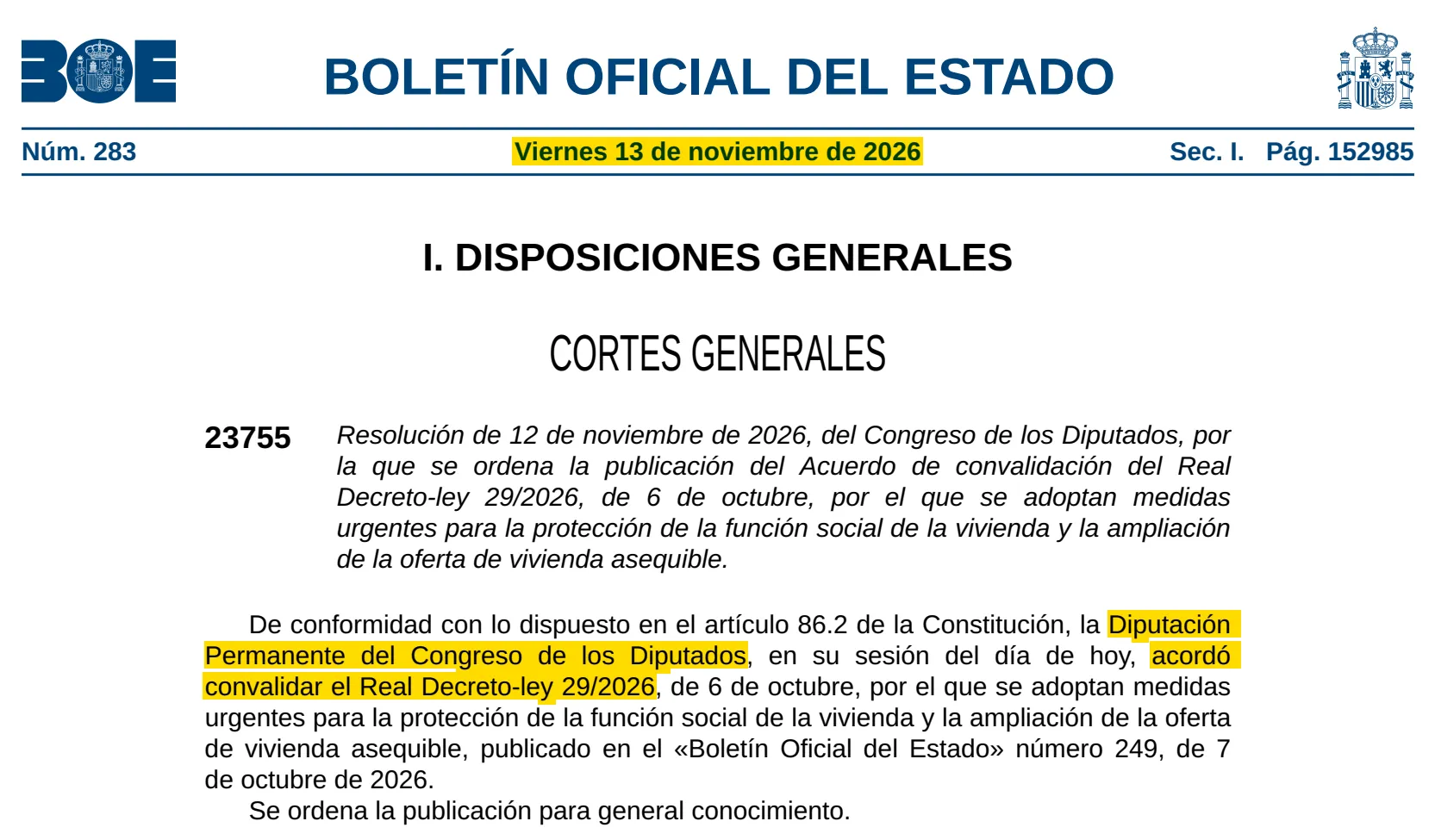
A decree-law of the Spanish government on housing, published in the Boletín Oficial del Estado on October 7, 2026 and in force the next day, October 8, 2026. A decree-law applies at once, and the Congress then has to ratify it: its standing committee, the Diputación Permanente, did so on November 12, 2026, as the chambers are dissolved ahead of the general election. The BOE printed the ratification on November 13, 2026.
Its full name speaks of protecting the social function of housing and widening the supply of affordable homes. It has six parts: tenancy law and evictions, taxes on housing (its articles 6 to 10), public housing, funding for builders, loans for first homes, and a new savings account. For an owner who lives abroad, the tax part is what matters, and not all of it.
What changes for an owner who lives abroad, and from when?
Five changes concern a home in Spain owned from abroad, each from its own date:
October 8, 2026
The decree is in force; tax year 2026 keeps the 1.1% rule for homes not rented out.
November 12, 2026
The Congress ratifies it: everything it set stays.
December 1, 2026
VAT on lets of 30 nights or fewer; new rules for the reduced VAT on works; new maximum coefficients for the plusvalía.
January 1, 2027
A scale on the sum of cadastral values replaces the two percentages for homes not let; towns may surcharge the IBI of tourist lets in stressed housing zones, once their by-laws say so.
The decree also changes the income tax of Spanish residents and the law on tenancies: both are at the end of this guide, with what stays the same for you.
Does the 1.1% rate stay for tax year 2026?
Yes. A home you don't let is taxed on a notional income, a percentage of its cadastral value: 1.1% where the town's values were revised in a general valuation in force since 2012, 2% elsewhere. That rule covered tax years up to 2025; article 6 of the decree extends it to 2026, with effect from the start of that year.
So nothing changes for your 2026 return: the same percentage as last year, the same tax rate on it (19% for residents of the EU, Iceland, Norway and Liechtenstein, 24% for everyone else), on Modelo 210. Its window runs from April 1, 2027 to December 31, 2027: see Modelo 210 deadlines.
Which percentage your home takes depends on the year its town's values were last revised, which the catastro page shows for each town; how the tax is worked out, day by day, is in our guide to the tax on an empty home in Spain. The non-resident tax in Spain simulator does the sum for you.
What changes from 2027 for a home you don't let?
From January 1, 2027, the decree replaces the two percentages with a scale on the sum of the cadastral values of an owner's homes, the main home left out: 1.1% up to €100,000, then rising by bands to 3% on the part above the last one. Whether the town's values were revised no longer counts.
Watch out
The decree writes the scale into the residents' income tax law, and the non-residents' law applies it through a cross-reference. How the sum works for a non-resident (Spanish homes only, a co-owner's share, one return per home) hasn't been published by the decree or the Agencia Tributaria, as of November 13, 2026. Your 2026 return, filed in 2027, is not concerned: the scale applies to tax year 2027 on.
Does your holiday let pay VAT from December 1, 2026?
Yes, if you let a furnished home to the same guest for 30 nights or fewer, unless it is the home you live in; and, whatever their length, lets with hotel services such as cleaning during the stay, which already paid VAT. Article 7 of the decree ends the exemption of those short lets from December 1, 2026; they pay the reduced rate of 10%. Lets of more than 30 nights without hotel services stay exempt.
Spanish VAT covers the mainland and the Balearic Islands, not the Canary Islands, Ceuta or Melilla. There is no threshold for a small owner: from your first taxable let, you register, charge the VAT, invoice your guests and file a VAT return each quarter; if you live outside the EU (Norway aside), you also need a tax representative in Spain. How VAT applies to stays booked and paid before December 1, 2026 hasn't been settled yet. Which lets pay, case by case, is in our guide to VAT on short term lets in Spain; the service that does it for you is on our page on VAT holiday rental in Spain.
The VAT doesn't replace the income tax on the rent: it still goes on each owner's Modelo 210.
We file your holiday-let VAT
 Registration: Modelo 036
- Each quarter's Modelo 303
- We pay it, you get the proof
Does it change the VAT on works in your home?
Yes, from December 1, 2026, for renovation and repair works. The reduced rate of 10% on such works, instead of 21%, now has a new condition, for every home: the builder must be paid by card, bank transfer, named cheque or deposit into a bank account. Paid in cash, as we read it, they lose the reduced rate and pay 21%.
The other conditions stay: you order the works as a private person for your own use of the home, the home was finished at least two years before, and the materials the builder supplies stay under 40% of the price. The decree also extends the reduced rate to works on a home let as someone's habitual home, whoever the landlord is. Works on a home you let to tourists are another case, as we read it: your lets make you a business for VAT, so these works are not for your private use, and their VAT is deducted from the VAT you charge.
Can your town raise the IBI of a holiday let?
Only in a stressed housing zone (zona de mercado residencial tensionado), and only if the town adopts it in its by-law. Article 8 lets such towns add a surcharge to the IBI of homes used as tourist accommodation, identified as such under the region's rules:
- up to 50% of the IBI;
- up to 100% for owners of two or more homes let to tourists;
- up to 150% for owners of four or more.
It applies to tax periods starting after the decree came into force: the IBI's year starts on January 1, so the IBI of 2027 at the earliest, as we read it. The surcharge falls due at the end of each year, and the town settles it once a year.
The same article rewrites the surcharge on homes left empty for over two years without a justified reason: outside stressed zones it targets owners of several homes, inside them it can reach any owner; a second home counts as justified for up to four years. That one is explained in our guide to the surcharge for empty homes; the IBI itself, in our guide to property taxes in Spain for non residents.
What changes for the plusvalía when you sell?
The maximum coefficients of the plusvalía municipal, the town's tax on the rise in the land's value, change for sales from December 1, 2026. The town multiplies the land's cadastral value by a coefficient for the years you owned the home, within the State's maximum, then applies its rate. Against the table before, the new maximums are higher for every period under 17 years and lower from 17 years on:
1
- Maximum before December 1, 2026
- 0.15
- Maximum from December 1, 2026
- 0.16
5
- Maximum before December 1, 2026
- 0.18
- Maximum from December 1, 2026
- 0.19
10
- Maximum before December 1, 2026
- 0.12
- Maximum from December 1, 2026
- 0.22
15
- Maximum before December 1, 2026
- 0.09
- Maximum from December 1, 2026
- 0.11
20 or more
- Maximum before December 1, 2026
- 0.40
- Maximum from December 1, 2026
- 0.30
| Years of ownership | Maximum before December 1, 2026 | Maximum from December 1, 2026 |
|---|---|---|
| 1 | 0.15 | 0.16 |
| 5 | 0.18 | 0.19 |
| 10 | 0.12 | 0.22 |
| 15 | 0.09 | 0.11 |
| 20 or more | 0.40 | 0.30 |
When the seller lives outside Spain, the law makes the buyer pay the plusvalía in the seller's place. The State's tax on the gain is another tax, filed on Modelo 210: our page on capital gains tax in Spain works out both.
What doesn't the decree change for you?
- The Modelo 210 calendar. The 2025 return of a home not let is still due by December 31, 2026, the last one with a whole-year window; every other deadline is set elsewhere and stays.
- The tax rates: 19% or 24%, as before.
- The new rent reductions. The decree rewrites the reductions Spanish residents take on the rent of a long let; a non-resident is taxed on the full rent, without reductions, so they don't apply on Modelo 210.
- The residents' measures: the deduction for rent paid, the new savings account, the levy on listed property companies.
What else does it change for landlords?
Tenancy law, which is outside this guide: the decree rewrites rules of the Ley de Arrendamientos Urbanos on seasonal and temporary lets, lets a tenant extend a habitual-home lease ending in the next few years, limits yearly rent updates for a time, and sets what every advert of a let must show, such as the let's registration number where there is one. If you let your home on a long lease, ask a lawyer how these rules touch your contract.
Is Real Decreto-ley 29/2026 final?
Yes. The Diputación Permanente ratified it on November 12, 2026, and the ratification is in the BOE of November 13, 2026: it stays in force as it was published. Its predecessor, Real Decreto-ley 26/2026, carried the same rule for homes not let and fell when the Congress voted against it; this one replaced it a few days later.
Changing it now takes a new law or decree-law. Each change and its date is on our page of Modelo 210 rule changes.
How we checked this guide
We read the official texts below and update this guide whenever the rules change. It is general information, not advice on your own situation.
- Real Decreto-ley 29/2026, de 6 de octubre (BOE-A-2026-20823): arts. 6, 7, 8 y 10 — read on November 13, 2026
- Resolución de 12 de noviembre de 2026, del Congreso de los Diputados, convalidación del Real Decreto-ley 29/2026 (BOE-A-2026-23755) — read on November 13, 2026
- Agencia Tributaria, Principales novedades tributarias introducidas por el Real Decreto-ley 29/2026 — read on November 13, 2026
- Agencia Tributaria, Novedades de normativa 2026 (IVA): Real Decreto-ley 29/2026 — read on November 13, 2026
- Real Decreto Legislativo 5/2004, texto refundido de la Ley del Impuesto sobre la Renta de no Residentes (art. 24) — read on November 13, 2026
- Real Decreto Legislativo 2/2004, texto refundido de la Ley Reguladora de las Haciendas Locales (arts. 72, 106 y 107) — read on November 13, 2026
- Real Decreto 806/2026, de disolución del Congreso de los Diputados y del Senado (BOE-A-2026-20742) — read on November 13, 2026


