 New


Tax on empty home in Spain: what you owe without renting it out
Tax on empty home in Spain: if you live abroad and own a home there that you don't rent out, you owe Spanish income tax on it every year, even when it earns nothing and nobody sets foot in it. Spain treats a small share of its cadastral value as if it were income, and taxes that.
By the CasitaTax team · Updated November 13, 2026 · 8 min read
In short
 Empty or used by you, the same tax: an individual who lives abroad and owns an urban home in Spain, not rented out, declares a notional income on it.
- The income is 1.1% or 2% of the cadastral value, on your IBI bill (rules for 2026), and the tax on it is 19% in the EU and the EEA, 24% elsewhere.
- No expense can be deducted: not the IBI, not the mortgage, not repairs.
- Only the days count: a home owned or left unrented for part of the year pays in proportion.
- A separate surcharge: some towns can add to the IBI of a home empty for over two years, mostly for owners of several homes, and from 2027 in stressed housing zones where the town adopts it. A second home counts as justified for up to four years.
On this page
Do you pay tax on a home in Spain you don't rent out?
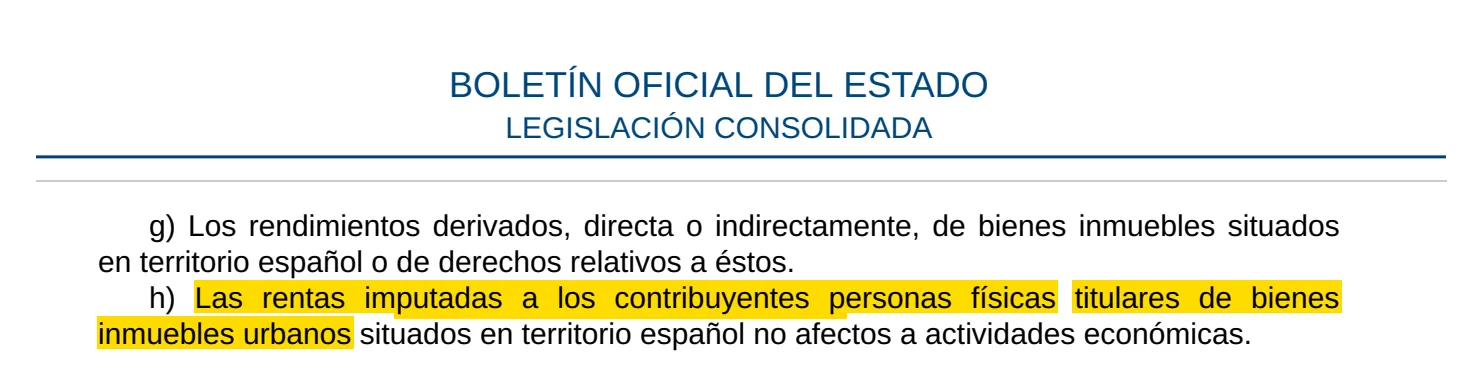
Yes, if you are an individual who lives abroad for tax purposes. Spain's non-resident income tax covers a notional income for the owner of an urban home that isn't used for a business. The Agencia Tributaria spells out both cases: the home you use yourself, and the home that stays empty.
It isn't a tax for having a home empty: an owner who spends every August there pays the same. Nor is it the IBI, the town's own property tax, which you pay as well, with the other property taxes in Spain for non residents. The return for it is Modelo 210, and a double tax treaty doesn't remove it: the Agencia Tributaria notes that treaties let the country where a home stands tax it, even when the owner only uses it.
This guide follows the State's rules. A home in Navarre or the Basque Country falls under their own tax offices.
How much tax do you pay on an empty home?
Your tax is the cadastral value, multiplied by a percentage to give the notional income, multiplied by your tax rate.
- 1Find the cadastral value (valor catastral) on the IBI bill.
- 2Apply the percentage for the tax year: 1.1% or 2%, as the next section explains. That gives the notional income.
- 3Take your share of it, if the home has several owners. Whoever holds a usufruct declares in the owner's place.
- 4Apply your rate: 19% if you live in the EU, Iceland, Norway or Liechtenstein, 24% everywhere else, the United Kingdom included.
1.1%: income of €1,320.00
- EU or EEA (19%)
- €250.80
- Elsewhere (24%)
- €316.80
2%: income of €2,400.00
- EU or EEA (19%)
- €456.00
- Elsewhere (24%)
- €576.00
| Cadastral value €120,000 | EU or EEA (19%) | Elsewhere (24%) |
|---|---|---|
| 1.1%: income of €1,320.00 | €250.80 | €316.80 |
| 2%: income of €2,400.00 | €456.00 | €576.00 |
Owners of a share pay on that share: a couple who own half each file a return each, as our guide to Modelo 210 co-owners sets out. For your own home, the non-resident tax in Spain simulator does the sum.
How do you know which percentage applies?
It depends on your town, not on your home. For tax years 2023 to 2026, the percentage is 1.1% where the town's cadastral values were revised by a general valuation that took effect in 2012 or later, and 2% everywhere else.
The year of a town's last general valuation is public: the Agencia Tributaria points to the Ponencias de Valores section of the Catastro's portal. The non-resident tax in Spain simulator also looks it up for you if you pick your town.
If the home has no cadastral value on the last day of the year, or the value was never notified to you, the income is 1.1% of a different base: 50% of the higher of what you paid for it or the value the administration has checked for another tax.
Can you deduct the IBI, the mortgage or repairs?
No. The Agencia Tributaria says the tax is due on that base "without deducting any kind of expense". That leaves out the IBI, mortgage interest, community fees, insurance and repairs. From the tax itself, only donations can be deducted, under the rules for them.
Expenses come in only when the home is rented out, and then only for owners living in the EU or the EEA. For those days, the return is a different one.
What if you owned or rented it for only part of the year?
You pay for the days that count. The amount for a full year is reduced in proportion when you didn't own the home all year, or when it was rented out for part of it.
Days rented out
- 73 of 365
Days to declare here
- 292
Notional income for those days
- €1,056.00
Tax (19%)
- €200.64
| Same home, 1.1%, living in the EU | |
|---|---|
| Days rented out | 73 of 365 |
| Days to declare here | 292 |
| Notional income for those days | €1,056.00 |
| Tax (19%) | €200.64 |
A year in which you were tax resident in Spain doesn't belong on this return: you are under the IRPF instead. And a year you forgot can still be filed: see Modelo 210 previous years.
When is no tax due on an empty home?
Far less often than owners hope. The law counts no income in a few cases:
- A home under construction, or one that can't be used for town-planning reasons: no income is counted.
- Bare land with nothing built on it.
- A timeshare of two weeks a year or less.
A home that is simply old or needs work isn't on that list. Lending it free to family doesn't change anything either, as we read the rule, because no rent is coming in. This rule is for individuals: a home owned through a company has other rules to check with an adviser. So does a home classed as rustic in the Catastro, as the non-resident act speaks only of urban property.
How and when do you declare it?
On a Modelo 210 per owner and per home, once a year. The 2025 return is due by December 31, 2026. From tax year 2026, the window runs from April 1 to December 31 of the following year: our Modelo 210 deadline guide gives every date.
To do it yourself, the Modelo 210 form in English shows the boxes, and the Modelo 210 predeclaración works without Spanish digital access. You can pay Modelo 210 from a bank abroad. A missed return has a price that grows with time: see Modelo 210 late filing.
We file your Modelo 210
 Every owner, every year
- You approve before we file
- 100% online
Is there a surcharge for empty homes in Spain?
Yes, on the IBI, and only where the town adopts it. Since 2023, towns have been able to add a surcharge to the IBI of a home left empty continuously, without a justified reason, for more than two years, when its owner has four or more homes. A decree of October 2026, ratified by the Spanish parliament on November 12, 2026, adds stricter rules in stressed housing zones, for tax years that start after it took effect. None of this goes through Modelo 210: the town charges it.
Outside a stressed housing zone
- Whose home
- Owner of four or more homes
- Up to
- 50% of the IBI, 100% beyond three years empty
- Since
- 2023
In a stressed housing zone
- Whose home
- Any owner
- Up to
- 50% of the IBI
- Since
- The decree of October 2026
In a stressed housing zone
- Whose home
- Owner of four or more homes
- Up to
- 100% of the IBI
- Since
- The decree of October 2026
| Town | Whose home | Up to | Since |
|---|---|---|---|
| Outside a stressed housing zone | Owner of four or more homes | 50% of the IBI, 100% beyond three years empty | 2023 |
| In a stressed housing zone | Any owner | 50% of the IBI | The decree of October 2026 |
| In a stressed housing zone | Owner of four or more homes | 100% of the IBI | The decree of October 2026 |
A second home counts as a justified reason, for up to four years of continuous emptiness. So do, among others, a temporary move for work or study, works on the home, a court or administrative case that prevents using or disposing of it, and offering it at market terms for sale (one year at most) or for rent (six months at most). Past those limits the other conditions still apply. The town must follow its own by-law, hear you and show signs that the home is empty, which may include the census or utility use: each by-law decides how this is proved.
What changes for 2026 and 2027?
The same decree touches this tax, and the Spanish parliament ratified it on November 12, 2026. Follow it on our page of rule changes.
- Tax year 2026: the decree keeps the 2012 rule: 1.1% where the town's values were revised in a general valuation in force since 2012, 2% elsewhere. The return is filed from April 1, 2027 to December 31, 2027.
- From 2027: the decree replaces the two percentages with a rising scale on the sum of your cadastral values. How that applies to non-residents hasn't been published.
The window to file doesn't depend on the decree.
How we checked this guide
We read the official texts below and update this guide whenever the rules change. It is general information, not advice on your own situation.
- Real Decreto Legislativo 5/2004, texto refundido de la Ley del IRNR (arts. 13, 24, 25 y 26) — read on November 9, 2026
- Ley 35/2006, del IRPF (art. 85 y disposición adicional 55.ª) — read on November 9, 2026
- Real Decreto-ley 29/2026, de 6 de octubre (arts. 6 y 8, BOE-A-2026-20823) — read on November 12, 2026
- Congreso de los Diputados, 130/000060: Real Decreto-ley 29/2026, convalidado — read on November 12, 2026
- Real Decreto Legislativo 2/2004, Ley Reguladora de las Haciendas Locales (art. 72) — read on November 9, 2026
- Agencia Tributaria, Renta imputada de inmueble urbano para uso propio — read on November 9, 2026
- Agencia Tributaria, Manual de Tributación de No Residentes (octubre 2026), capítulo 3 — read on November 9, 2026


