 New


How to pay Modelo 210 from your bank abroad
You don't need a Spanish bank account. Here is how to pay Modelo 210 from the account you already have: a transfer with a payment ID, a direct debit from any account in the SEPA zone, or a card, what each one needs, when the payment counts and why a transfer comes back.
By the CasitaTax team · Updated November 4, 2026 · 11 min read

In short
 Transfer from abroad: the form gives you the tax office's account and a payment ID valid 30 days. Send euros, with the ID alone as the reference. With the predeclaración, no electronic ID needed.
- Direct debit: from an account in your name anywhere in the SEPA zone (the United Kingdom and Switzerland included), when you file online, within a window that closes before the filing deadline, never after a sale.
- Card: through the tax office's payment gateway, when you file online with Cl@ve Móvil, a certificate or a Spanish electronic ID card. It gives you an NRC, the proof of payment you file with.
- When it counts: a transfer on the day it reaches the tax office, a direct debit on the day it is taken, a card on the day you pay. Send a transfer days before the deadline.
On this page
How can you pay Modelo 210 without a Spanish bank account?
In three ways: a transfer from your bank abroad, a direct debit from an account in the SEPA zone, or a card. Which ones are open to you depends on how you file: the paper route, the Modelo 210 predeclaración, only takes the transfer; filing online adds the direct debit and, if you log in with Cl@ve Móvil, a certificate or a Spanish electronic ID card, the card.
Transfer from abroad
- How you file
- Predeclaración, or online
- What it needs
- A bank outside the tax office's collaborating banks; euros; the payment ID
- It counts
- When the money reaches the tax office
Direct debit
- How you file
- Online only
- What it needs
- An account in your name in the SEPA zone; within the window; not after a sale
- It counts
- On the day it is taken
Card (NRC)
- How you file
- Online only
- What it needs
- Cl@ve Móvil, a certificate or a Spanish electronic ID card
- It counts
- On the day you pay; file the same day
Spanish bank account
- How you file
- Either
- What it needs
- An account at one of the tax office's collaborating banks
- It counts
- On the day you pay at the bank
| Way to pay | How you file | What it needs | It counts |
|---|---|---|---|
| Transfer from abroad | Predeclaración, or online | A bank outside the tax office's collaborating banks; euros; the payment ID | When the money reaches the tax office |
| Direct debit | Online only | An account in your name in the SEPA zone; within the window; not after a sale | On the day it is taken |
| Card (NRC) | Online only | Cl@ve Móvil, a certificate or a Spanish electronic ID card | On the day you pay; file the same day |
| Spanish bank account | Either | An account at one of the tax office's collaborating banks | On the day you pay at the bank |
The amount is the same whichever way you pay: the free non-resident tax in Spain simulator works it out for a home you don't rent out.
How do you pay Modelo 210 by bank transfer from abroad?
Choose the transfer as the way to pay in the form, and it gives you the tax office's account, the amount and a payment ID; you then send the transfer from your own bank. With the predeclaración it needs no electronic ID, which makes it the usual route for owners abroad.
- 1In the form, choose "A ingresar mediante transferencia bancaria desde el extranjero" (predeclaración) or, online, "Reconocimiento de deuda y pago mediante transferencia".
- 2Enter the first eight characters of the IBAN you will pay from (an account without an IBAN: the first eight characters of its number and the bank's BIC/SWIFT), and tick that you accept the conditions of payment by transfer.
- 3Generate the predeclaración, or file online. You get the tax office's IBAN and BIC/SWIFT, the amount, the payment ID and the last day it must be received.
- 4In your bank, send the exact amount in euros, to that IBAN, with the payment ID alone in the reference field: no name, no NIE, no invoice number.
- 5Send it well within the 30 calendar days the ID lasts, and days before the return's deadline: it counts when the money arrives, not when you send it.
- 6Keep your bank's confirmation with the PDF. Once the money has arrived, a payment receipt can be downloaded from the Agencia Tributaria's website, if you can log in there.
Good to know
Send the full amount, your bank's charges paid by you (often called OUR). The rules don't say what happens when charges are taken off on the way and the tax office receives less: don't find out.
The account changes: always use the one your own form gives you, never an account found online. The old account at the Banco de España, still quoted on some websites, no longer takes these payments.
Why does a Modelo 210 transfer come back?
Because the tax office can't match it to your return: the transfer is sent back to your bank, its charges at your cost, and it doesn't count as a payment. A predeclaración paid that way isn't filed at all.
- The reference: the payment ID missing, incomplete, or with anything added to it.
- Too late: received after the ID's 30 days.
- Another currency: pounds, kronor or francs are sent back; the transfer must be in euros.
- A collaborating bank: the transfer from abroad is refused from an account at one of the tax office's collaborating banks. The list includes the Spanish branches of some online banks: if yours has one, check the list before you send; if your bank is on it, pay by direct debit or card instead.
If yours comes back, generate a new payment ID (a new predeclaración, or the payment of the return you filed online) and send it again. Past the deadline, a predeclaración is filed late, with a surcharge: 1% plus 1% per full month, as our guide to the Modelo 210 deadline explains.
We file your Modelo 210
 Every owner, every year
- You approve before we file
- 100% online
Can you pay Modelo 210 by direct debit from an account abroad?
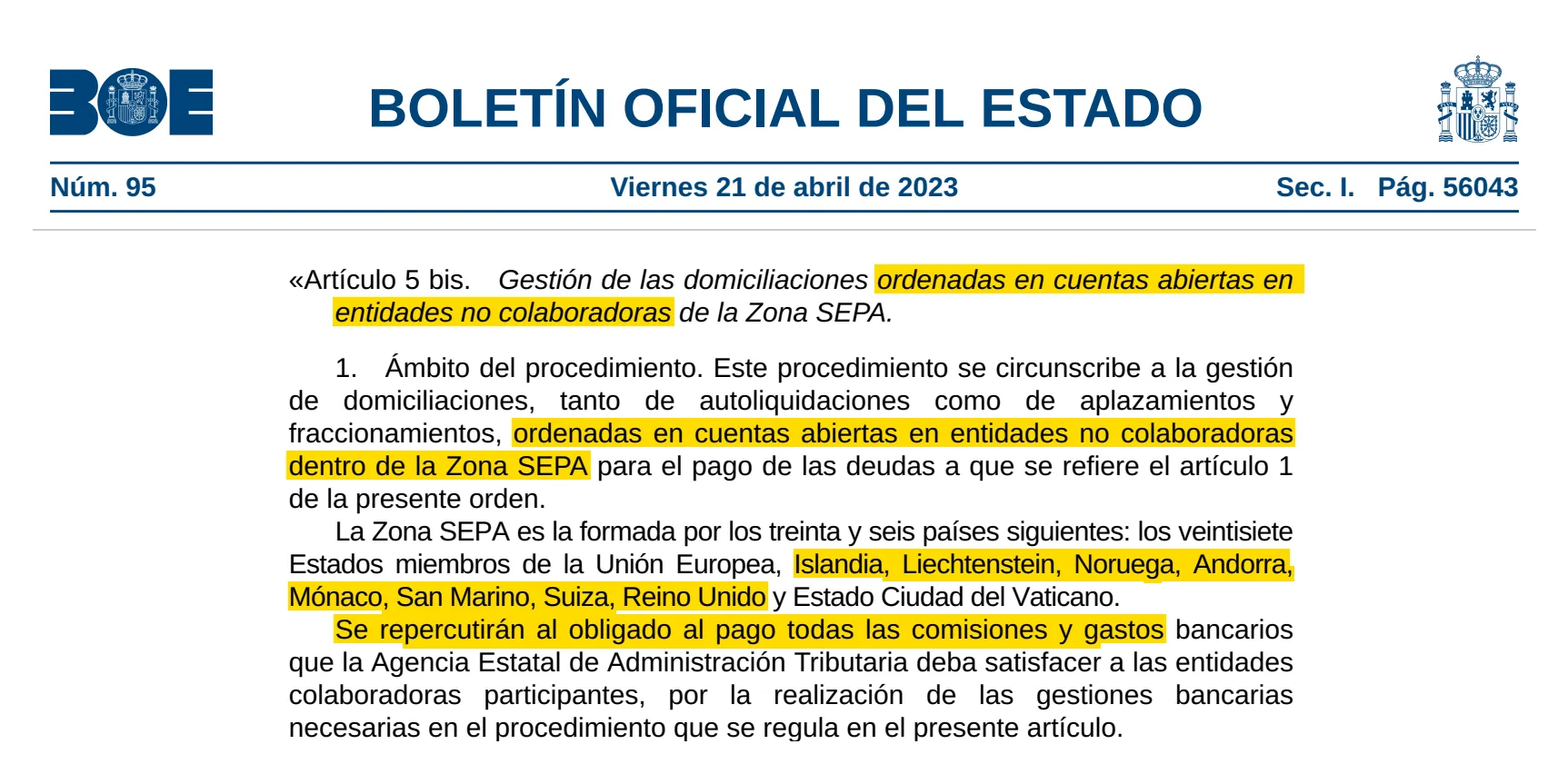
Yes, from an account anywhere in the SEPA zone, when you file online: the European Union, Iceland, Liechtenstein, Norway, Andorra, Monaco, San Marino, Switzerland, the United Kingdom and the Vatican. You sign the direct-debit mandate electronically while filing. The debit is in euros: an account in pounds or francs must be able to take a SEPA direct debit in euros, so ask your bank first.
- In your name: the account must belong to you, the owner, or to the person filing the return for you.
- Within its window, which closes before the filing deadline: the dates are below.
- Never after a sale: the return on a sale's gain can't be paid by direct debit.
- Taken when the direct-debit window closes (the exact day isn't published), not the day you file: the payment counts on the day it is taken. Keep the money in the account until then.
- In full or not at all: if your bank takes less than the tax and any charges, the whole amount is sent back. Bank charges are passed on to you (the tax office says none are charged at present; this may change). Reversing the debit with your bank cancels the payment.
December 23, 2026
Last day to file with direct debit: home not rented out in 2025
April 1, 2027 to April 15, 2027
Direct debit for 2026 rent with tax to pay
April 1, 2027 to December 23, 2027
Direct debit for a home not rented out in 2026
Some of the Agencia Tributaria's pages still give the old window, opening in January: from the 2026 tax year, the order that sets it opens it on April 1.
Can you pay Modelo 210 by card?
Yes, when you file online: the form's "Realizar pago (Obtener NRC)" button opens the tax office's payment gateway, which takes a debit or credit card, or Bizum. An Agencia Tributaria manual says its card payments take cards issued in Spain or abroad.
- An NRC comes back: a 22-character code proving the payment. The form uses it to file the return, which must be sent the same day as the payment.
- An electronic ID: paying through the gateway needs a certificate, a Spanish electronic ID card or Cl@ve Móvil. The page that takes cards without logging in works only for some forms for now (the tax office names 303 and Renta): for Modelo 210, the card goes through the online form.
- Bizum only if you already use it with a bank that offers it.
Without any electronic ID, the card isn't open to you: pay by transfer. Getting Cl@ve or a certificate from abroad is in our guide to the Modelo 210 predeclaración.
What if you have a Spanish bank account?
Pay through it, if your bank is one of the tax office's collaborating banks (the Agencia Tributaria publishes the list). With the predeclaración, paying at the bank files the return; online, the bank gives you an NRC to file with, the same day.
- Predeclaración: take the printed PDF to the bank, or pay it through its online banking or a cash machine.
- Online: pay at the bank for an NRC and file with it the same day, or choose a direct debit from that account.
From an account at a collaborating bank, the transfer from abroad is refused: use one of the two ways above.
When does your Modelo 210 payment count?
It depends on how you pay, and that day must fall within the deadline.
- Predeclaración paid by transfer: the return is filed, and paid, on the day the money is credited to the tax office's account.
- Online with a transfer: the return is filed when you send it; the payment counts when the transfer arrives, by the last day the form gives you.
- Direct debit: on the day it is taken from your account.
- Card or Spanish bank: on the day you pay, with the return filed the same day.
A return filed online on time but paid after the deadline isn't late as a return: the unpaid tax goes into the tax office's enforcement period (período ejecutivo), with a surcharge that grows once it sends you an enforcement notice. When each return is due: our guide to the Modelo 210 deadline.
Can someone else pay it for you?
Yes: Spanish tax rules let anyone pay someone else's tax. Each way to pay sets its own condition.
- Transfer: the rules set no condition on who holds the account; enter the first characters of the IBAN the money will actually leave from.
- Direct debit: only from your account, or that of the person filing the return for you.
- Predeclaración: you, the owner, must be the person filing it, even when someone else sends the money.
Or let us deal with it: we file your Modelo 210 and tell you what to pay and how, before each deadline.
How do you pay a tax office letter from abroad?
With the payment number on the letter: when the Agencia Tributaria assesses a tax or a surcharge, its letter comes with a payment slip (carta de pago) whose number you pay against, from abroad too.
- By card or Bizum, on its website, without logging in: enter the form number and the slip's number.
- By transfer from abroad, from a bank that isn't one of the tax office's collaborating banks: without logging in, or with eIDAS, enter the slip's number and the first eight characters of your IBAN; you get an account and a payment ID valid 30 days, as for a return.
- At a Spanish bank, with the slip printed.
Can you pay Modelo 210 in instalments?
You can ask: when you can't pay for now, the Agencia Tributaria can grant a deferral or instalments (aplazamiento o fraccionamiento). It decides each request; filing the return doesn't count as asking.
- Online: choose "Reconocimiento de deuda con solicitud de aplazamiento" in the form, then make the request, logged in with a certificate, a Spanish electronic ID card, Cl@ve or eIDAS.
- Paid by direct debit, from an account at a Spanish collaborating bank or anywhere in the SEPA zone.
- Within the deadline: a request made before the deadline keeps the tax out of the enforcement period while it is examined.
Can a Modelo 210 refund go to an account abroad?
Yes, if the account is in your own name, in the SEPA zone or elsewhere: give its IBAN and BIC/SWIFT (outside the SEPA zone, the account number and the bank's name, address and BIC/SWIFT).
- Proof: the return comes with a document showing the account is yours, such as a bank certificate.
- In someone else's name: a representative's account must be in Spain.
What goes on the form's payment page, refund included: our Modelo 210 form in English, box by box.
How we checked this guide
We read the official texts below and update this guide whenever the rules change. It is general information, not advice on your own situation.
- Orden EHA/3316/2010, modelos 210, 211 y 213 (texto consolidado: arts. 3, 11 a 14) — read on November 3, 2026
- Orden EHA/1658/2009, domiciliación del pago (texto consolidado: arts. 2, 5, 5 bis y 6) — read on November 3, 2026
- Orden EHA/2027/2007, entidades colaboradoras y NRC (texto consolidado: arts. 4 y 5) — read on November 3, 2026
- Real Decreto 939/2005, Reglamento General de Recaudación (arts. 33 a 38) — read on November 3, 2026
- Ley 58/2003 General Tributaria (arts. 27, 28 y 161) — read on November 3, 2026
- Agencia Tributaria, formas de presentación y pago del modelo 210 — read on November 3, 2026
- Agencia Tributaria, nota sobre las modificaciones de los plazos del modelo 210 — read on November 3, 2026
- Agencia Tributaria, pago de liquidaciones y deudas mediante transferencia bancaria — read on November 3, 2026
- Agencia Tributaria, entidades bancarias adheridas al pago de impuestos — read on November 3, 2026


