 New


Modelo 210 late filing: what it costs, and what to do
Modelo 210 late filing costs a surcharge, not a penalty, if you have tax to pay and file before the tax office writes to you. Here is what you pay at each stage, how the bill reaches you, and how to catch up.
By the CasitaTax team · Updated November 5, 2026 · 10 min read
In short
 Before any letter: a surcharge of 1% of the tax, plus 1% per full month late, and no penalty.
- After twelve months: 15%, plus late interest from then on.
- A quarter off the surcharge if you pay the tax when you file, then the surcharge within its period.
- After a letter: interest, and a penalty can follow, from 50% of the tax.
- Nothing to pay: the law provides a fixed fine, €100 if you file before any letter.
On this page
How much does it cost to file Modelo 210 late?
It costs a share of the amount to pay (after a sale, what is left once the buyer's 3% is taken off), which grows with the delay: 1% in the first month, one point more per full month, then 15% once twelve months have gone by. This surcharge comes on top of the tax itself, and replaces the penalty you could otherwise face (Ley General Tributaria, art. 27).
Within the first month
- Surcharge
- 1%
- On €125.40 of tax
- €1.25
- With a quarter off
- €0.94
After three full months
- Surcharge
- 4%
- On €125.40 of tax
- €5.02
- With a quarter off
- €3.76
After six full months
- Surcharge
- 7%
- On €125.40 of tax
- €8.78
- With a quarter off
- €6.58
After eleven full months
- Surcharge
- 12%
- On €125.40 of tax
- €15.05
- With a quarter off
- €11.29
After twelve months
- Surcharge
- 15%, plus interest
- On €125.40 of tax
- €18.81, plus interest
- With a quarter off
- €14.11, plus interest
| When you file | Surcharge | On €125.40 of tax | With a quarter off |
|---|---|---|---|
| Within the first month | 1% | €1.25 | €0.94 |
| After three full months | 4% | €5.02 | €3.76 |
| After six full months | 7% | €8.78 | €6.58 |
| After eleven full months | 12% | €15.05 | €11.29 |
| After twelve months | 15%, plus interest | €18.81, plus interest | €14.11, plus interest |
The percentages are the same for every return with tax to pay: a home not rented out, rent or a sale. For a home not rented out, what your own tax comes to for a past year, with that year's rates: the past-years calculator. For this year's, the non-resident tax in Spain simulator.
Is it a surcharge or a penalty?
A surcharge, if you file of your own accord: the law sets it out in place of any penalty. It stops being available once the tax office has started on the tax debt with you: from then on, a penalty can apply instead.
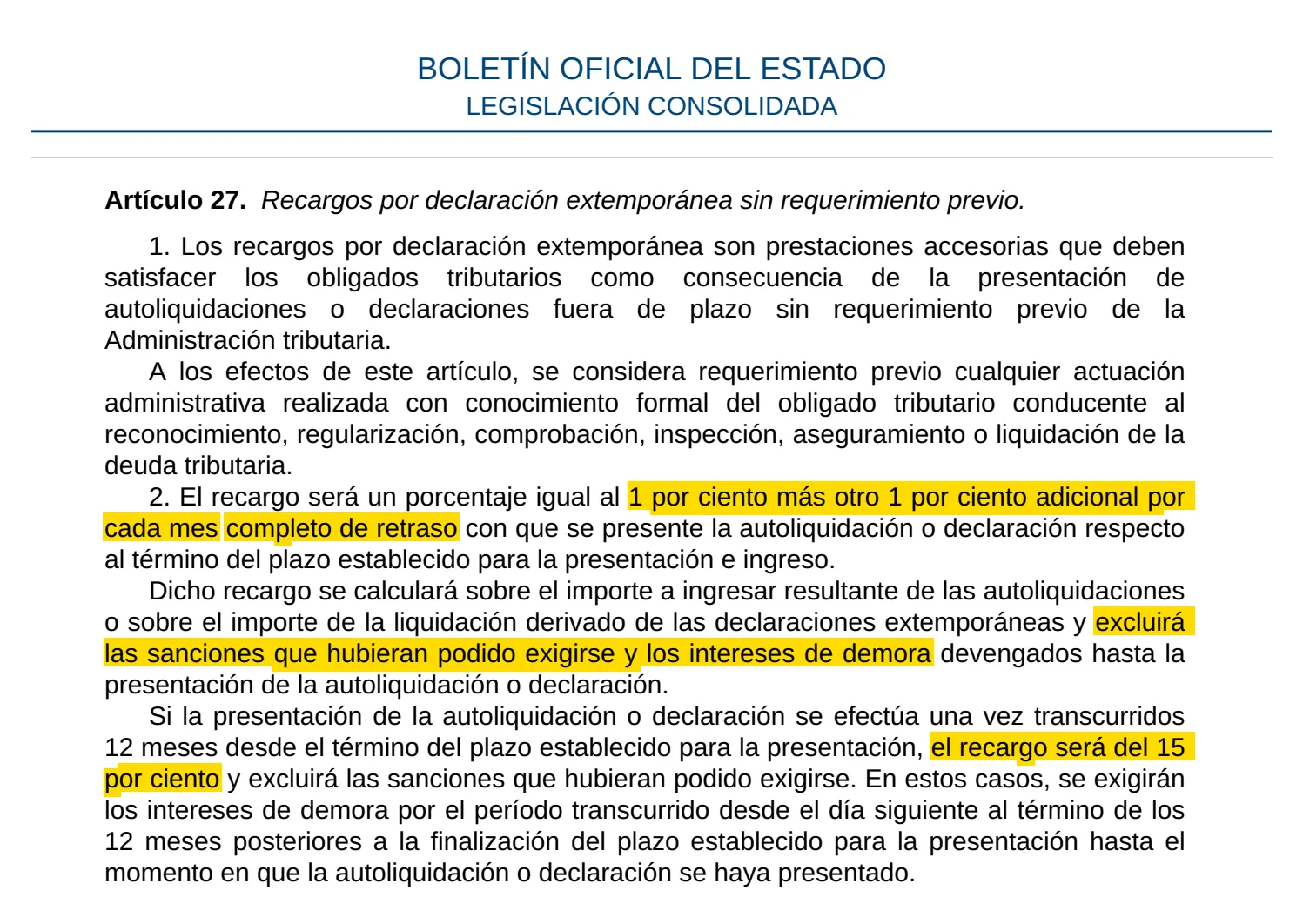
What counts as a letter? The law calls it a requerimiento previo: any action by the tax office, formally brought to your knowledge, aimed at establishing, checking or assessing the tax debt. As we read it, what matters is that it reached you formally, not whether you answered. A letter on another matter doesn't necessarily count: check what it concerns.
How is the delay counted?
From the end of that return's own filing window, in full months: the windows are in our guide to the Modelo 210 deadline. When a window ends on the last day of a month, as we count it, the rate moves on the first of each month. Take the 2024 return of a home not rented out:
December 31, 2025
Last day of the window: no surcharge
From January 1, 2026
Surcharge of 1%
From February 1, 2026
Surcharge of 2%, then one point more each month
From July 1, 2026
Surcharge of 7%
From December 1, 2026
Surcharge of 12%
From January 1, 2027
Surcharge of 15%, and interest starts
So there is a step to avoid: from the end of the twelfth month, the surcharge jumps to 15% and interest starts to run.
When is interest added to a late Modelo 210?
Only after twelve months, when you file before any letter and pay when you file. Up to then, the surcharge replaces interest. After that, interest runs on the tax, day by day, from the day after the twelve months until you file: 4.0625% a year in 2026, until a new budget law changes it. On €125.40 of tax, that is about €5.09 for a full year.
How do you get the surcharge cut by a quarter?
By paying twice on time: the surcharge falls by 25% if you meet both conditions below.
- The tax, when you file. The whole amount of the return, at the same time as the return. As we read it, a predeclaración paid by transfer, a card or a Spanish bank do both on one day; the online route with a transfer files first and pays later, which may not qualify.
- The rest of the surcharge, within the period of its assessment, in full.
If you miss the second payment, the tax office asks for the quarter back. Instalments keep the cut only if you ask for them when you file, and with a guarantee (a bank guarantee or an insurance certificate): for most owners, the way to keep it is to pay the tax with the return.
How does the surcharge reach you?
By a separate letter, when the tax office claims it: the instructions for the return say nothing about it, and you don't work it out yourself. The tax office starts the procedure on its own: first a proposal, with time for you to reply, then the assessment of the surcharge. It has six months once the procedure has started, not from the day you file.
The period to pay, and to keep the quarter off, opens with the assessment, not with the proposal. In an example about a company in the tax office's own manual, the assessment states the reduced amount; we expect the same for a Modelo 210. Pay within that period, against its payment slip: paying a tax office letter from abroad works by card, by transfer or at a Spanish bank.
Watch out
Every notification of the tax office also appears in its electronic mailbox, the DEHú. Keep your address right, and read our page on tax office letters: the period runs from the day a letter counts as delivered, and missing it costs you the quarter off.
We found no official figure for how long the letter usually takes. Keep the proof of filing and payment for at least the four years the tax office has to claim.
How do you file a late Modelo 210?
One by one, and as far as we can see on the same form as a return filed on time: the tax office's instructions have nothing special for a late one.
- 1List what is missing. For a home not rented out: one return per tax year, per owner and per home. Rent can mean several returns a year, each with its own window; a sale has its own. The law requires each late return to name its period and contain only that period: you can't group years.
- 2Use each year's rules: the rates of that tax year, not this year's. The tax office's online forms cover tax years from 2019 on.
- 3Fill in the form: returns filed from January 1, 2027 use the new form, whatever their year. Our Modelo 210 form guide goes through it box by box.
- 4File and pay at once: direct debit is only open within a window, so it isn't an option. Without Spanish online access, the Modelo 210 predeclaración works with a transfer from abroad; it is only filed once the transfer arrives.
- 5Keep the proof, then watch for a letter about the surcharge.
We file your Modelo 210
 Every owner, every year
- You approve before we file
- 100% online
If you would rather not do it yourself, Modelo 210 is what we do: we work out each missed year and file it for you, with the current year's.
What if the tax office writes to you first?
Then the surcharge is no longer available: you owe the tax and late interest from the end of the window, and a penalty can follow. The tax office has a procedure of its own for non-residents who haven't filed.
- Up to €3,000 of unpaid tax on a return: 50% of it.
- Above that, with no return filed: 50% to 100%, as not filing counts as concealment. As we read the grading rules, with nothing filed that means 75% before any reduction. Up to 150% with fraudulent means.
- The reductions: 30% off if you don't contest the assessment (in a check by letter, not appealing is enough), then 40% off the rest if you pay in full within the period without appealing. From 50%, that is 35%, then 21%.
For comparison: before any letter, after twelve months, a quarter off
- Penalty, if one applies
- No penalty: a surcharge of €14.11, plus interest after the twelve months
After a letter
- Penalty, if one applies
- €62.70, plus interest
After a letter, accepted
- Penalty, if one applies
- €43.89, plus interest
After a letter, accepted and paid on time
- Penalty, if one applies
- €26.33, plus interest
| On €125.40 of tax | Penalty, if one applies |
|---|---|
| For comparison: before any letter, after twelve months, a quarter off | No penalty: a surcharge of €14.11, plus interest after the twelve months |
| After a letter | €62.70, plus interest |
| After a letter, accepted | €43.89, plus interest |
| After a letter, accepted and paid on time | €26.33, plus interest |
A letter about one year: as we read the law, it concerns that tax and that year, so the other missing years can still be filed with a surcharge. We found no official statement on this. There is also one case with no surcharge at all, when, within six months of an assessment, you correct other years for identical facts, pay in full, don't appeal or ask to rectify, and that assessment brought no penalty. We found nothing saying whether it fits an owner who simply didn't file: ask before relying on it.
Whatever the letter is, it has a time limit: see our page on tax office letters.
What if your late return has nothing to pay?
There is no surcharge to work out, but a return with zero tax has a fixed fine: €200 under the law, halved to €100 if you file before any letter. A refund return on income other than a sale is not late within its four years. After a sale, the return has its own window whatever its result.
This fine is what the law provides: we haven't found how the tax office applies it to a Modelo 210, or what it does with a late refund after a sale.
What if you filed on time but didn't pay?
Then the tax goes into collection, with a different surcharge: 5% if you pay it all before the tax office's formal demand (providencia de apremio), 10% if you pay within the period of that demand, and 20% after that, plus interest.
- A failed direct debit: you still owe the tax. If the failure wasn't your fault (ordered in time, from your account, with enough funds, not cancelled), no surcharge, interest or penalty applies.
- A transfer sent back: a predeclaración paid by transfer isn't filed until the money arrives. If the Modelo 210 payment comes back, pay again; past the deadline, you are in the case of a late return.
- Filing late without paying: you owe these collection surcharges on the tax as well as the late-filing one, and you lose the quarter off. As we read the law, asking for a deferral when you file keeps them away while it is examined; if it is refused, they come back.
How many years back can the tax office claim Modelo 210?
The tax office generally has four years from the end of each window to claim a return, and the count starts again whenever it acts on it, or you do. The 2024 return, due by December 31, 2025, stays open until December 31, 2029, as we read the law, unless something restarts the count.
That is why people speak of five tax years: with returns filed the following year, five are open at once. This is no reason to wait: a letter ends the surcharge, any action by the tax office restarts the count, and the more recent years keep climbing to 15%, then collect interest: catching up on Modelo 210 previous years goes through them one by one. For a home not rented out, the past-years calculator shows which years are open today.
How we checked this guide
We read the official texts below and update this guide whenever the rules change. It is general information, not advice on your own situation.
- Ley 58/2003, General Tributaria (arts. 26–28, 62, 66–68, 161, 179, 184, 187, 188, 191 y 198) — read on November 4, 2026
- Real Decreto 939/2005, Reglamento General de Recaudación (art. 38) — read on November 4, 2026
- Orden EHA/3316/2010, modelos 210, 211 y 213 (texto consolidado) — read on November 3, 2026
- Orden HAC/623/2026, de 12 de junio (BOE-A-2026-13573) — read on November 3, 2026
- Ley 39/2015, del Procedimiento Administrativo Común (art. 30) — read on October 29, 2026
- Orden EHA/1658/2009, domiciliación bancaria (arts. 1 y 6) — read on November 4, 2026
- Agencia Tributaria, Liquidación de recargos por presentación fuera de plazo — read on November 4, 2026
- Agencia Tributaria, Manual práctico de Renta 2021: recargos aplicables — read on November 4, 2026
- Agencia Tributaria, Manual de Sociedades 2025: ejemplo de liquidación del recargo — read on November 4, 2026
- Agencia Tributaria, Regularización por falta de presentación del IRNR — read on November 4, 2026
- Agencia Tributaria, Modelo 210: gestiones e instrucciones — read on November 4, 2026
- Agencia Tributaria, Manual de tributación de no residentes: plazo de presentación — read on November 4, 2026
- Agencia Tributaria, Manual de IRPF 2025: interés de demora — read on November 4, 2026


