 New


Non resident tax rate Spain: 19% or 24%, depending on where you live
Non resident tax rate Spain: an owner who lives abroad pays Spain's non-resident income tax on the home at 19% if they live in the EU, Iceland, Norway or Liechtenstein, and 24% anywhere else, the United Kingdom, Switzerland and the United States included. Where you live decides, not your passport.
By the CasitaTax team · Updated November 18, 2026 · 9 min read

In short
 19% for residents of the EU, Iceland, Norway and Liechtenstein; 24% for everyone else (rules for 2026).
- The United Kingdom pays 24% on income accrued since January 1, 2021, after Brexit. Switzerland and the United States are at 24% too.
- The rate goes with the base: residents of the EU and the EEA may deduct the expenses of letting, everyone else is taxed on the gross rent.
- A sale is 19% for everyone, wherever you live.
- A double tax treaty doesn't lower it: Spain may tax its homes, and your own country deals with the double taxation.
On this page
What is the non-resident tax rate in Spain?
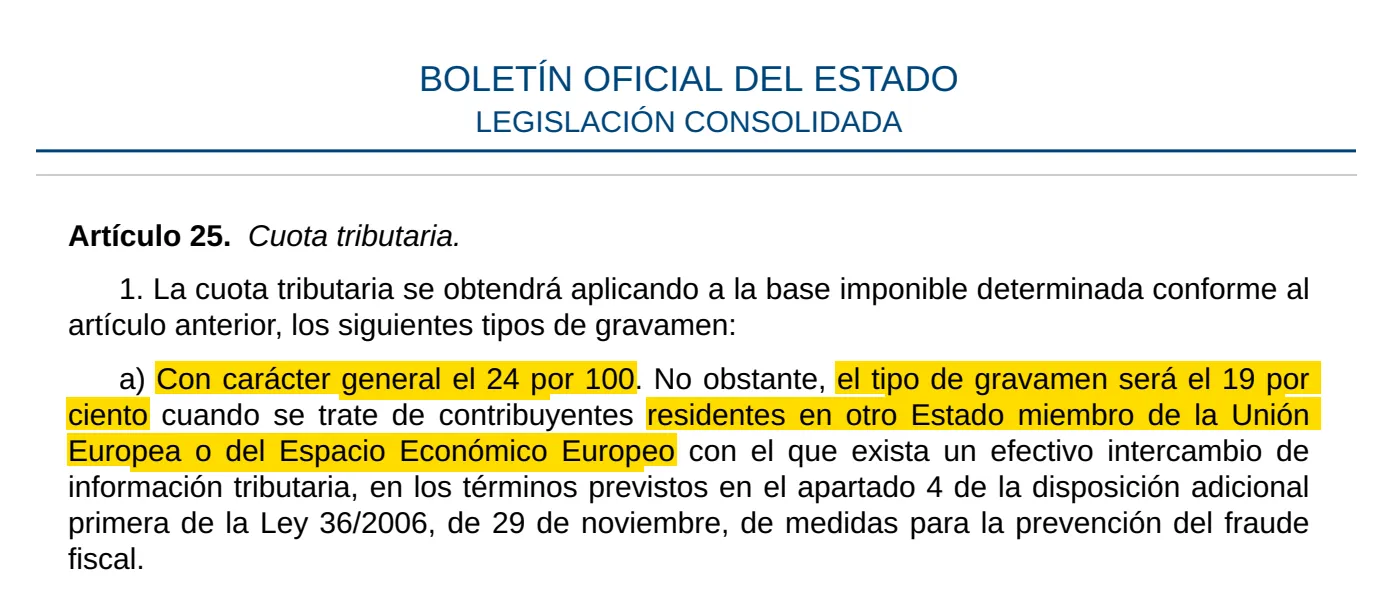
It is 19% or 24%, a flat rate with no allowance. The law sets 24% as the general rate, and 19% for residents of another member state of the European Union or of the European Economic Area that exchanges tax information with Spain.
The 27 EU countries
- Rate
- 19%
- Rent taxed on
- Rent after expenses
Iceland, Norway, Liechtenstein
- Rate
- 19%
- Rent taxed on
- Rent after expenses
United Kingdom, Switzerland, United States, everywhere else
- Rate
- 24%
- Rent taxed on
- Gross rent
| Where you live | Rate | Rent taxed on |
|---|---|---|
| The 27 EU countries | 19% | Rent after expenses |
| Iceland, Norway, Liechtenstein | 19% | Rent after expenses |
| United Kingdom, Switzerland, United States, everywhere else | 24% | Gross rent |
This guide covers an individual who owns the home directly and has no permanent establishment (a business base) in Spain. The return that carries it is Modelo 210.
Which countries get the lower rate?
The 27 member states of the European Union, and three countries of the European Economic Area: Iceland, Norway and Liechtenstein. The Agencia Tributaria's table of rates lists them that way.
The condition behind the EEA countries is an exchange of tax information with Spain. Spain changed how it defines that exchange on July 11, 2021, and Liechtenstein's residents have paid 19% on income accrued from that day; before it, 24%. Iceland and Norway were already at 19%.
No other country is at the lower rate, however close its ties with the EU. Switzerland, Andorra, Monaco and the United Kingdom are outside both the EU and the EEA, so their residents pay 24%.
Does your nationality or where you live decide?
Where you live for tax purposes. The law speaks of taxpayers resident in another member state, not of citizens. So:
- A British owner who lives in France pays 19%.
- A German owner who lives in Switzerland pays 24%.
- A Spanish national who lives in London is a non-resident too, and pays 24%.
Your residence is the country where you are resident for tax purposes, the one that taxes your worldwide income. If you are resident in Spain, this tax doesn't apply at all: you file the residents' income tax instead.
What rate do UK residents pay after Brexit?
24%, on income accrued since January 1, 2021, when the transition period ended. The Agencia Tributaria's note on Brexit says UK residents lost the rules Spain keeps for residents of the EU and the EEA:
- The rate: 24% instead of 19%, on rent and on the notional income of a home not rented out.
- The expenses: rent is taxed gross, without deducting the costs of letting.
- A few exemptions, such as the one for reinvesting the gain from selling a former main home in Spain in a new main home.
Years before 2021 kept the old rules. Every year still open today is 2021 or later, so a catch-up is at 24% throughout: our guide to Modelo 210 previous years explains which years those are.
The tax treaty between Spain and the United Kingdom still applies after Brexit, the Agencia Tributaria adds. It doesn't change the rate on a Spanish home, as the treaty section below explains.
What about Switzerland, the United States and other countries?
24%, like every country outside the EU and the EEA: Switzerland, the United States, Canada, Australia, Andorra, Monaco and the rest. Rent is taxed gross for them too.
Switzerland's close ties with the EU don't change this: the law names the EU and the EEA only, and Switzerland belongs to neither, so the Agencia Tributaria's table puts it with the other countries.
Whether residents of these countries may deduct their rental expenses is before the Spanish courts: see the section on gross or net rent below.
Which income is taxed at 19% or 24%?
The income a home gives its owner, in two cases:
- Rent, for the days the home is let.
- The notional income of a home you don't rent out, a share of its cadastral value, for the other days: see our guide to the tax on empty home in Spain.
A sale is different. The gain on selling the home is taxed at 19% for every non-resident, whether you live in Lyon, London or Zurich. On top, the buyer keeps 3% of the price and pays it to the tax office for you; your return after the sale settles the difference. Our page on capital gains tax in Spain works it out.
This guide is about the income of a home. Other income (pensions, dividends, interest) has rates of its own.
Is the rate charged on gross or net rent?
It depends on the same line between countries. Residents of the EU and the EEA can deduct the expenses directly related to the rent (the share of the IBI, community fees, insurance, repairs, interest, depreciation); everyone else is taxed on the gross rent. So the two rates are further apart than they look:
Living in the EU or the EEA (19%)
- Taxed on
- €6,000
- Tax
- €1,140
Living elsewhere (24%)
- Taxed on
- €10,000
- Tax
- €2,400
| Rent of €10,000, expenses of €4,000 | Taxed on | Tax |
|---|---|---|
| Living in the EU or the EEA (19%) | €6,000 | €1,140 |
| Living elsewhere (24%) | €10,000 | €2,400 |
That gap is being challenged. The Audiencia Nacional has let a United States resident deduct their expenses; the State appealed, and the Tribunal Supremo has taken the case. Until it rules, the Agencia Tributaria taxes the gross rent, as the wording of the act provides. Expenses don't count at all for a home you don't rent out, wherever you live.
What if you moved country during the year?
The rate follows where you lived when the income became due, as we read the law, because the tax is charged on each income as it falls due:
- The notional income of a home not rented out is due on the last day of the year: the country you lived in then decides the rate for the whole year's return.
- Rent is due when the tenant owes it, or when you are paid if that is earlier: rent before your move at one rate, rent after it at the other.
Rent at two rates can't share a return: the form's instructions only let you group income taxed at the same rate. Moving to Spain itself is another matter: a year in which you are resident in Spain goes on the residents' income tax return, not on Modelo 210.
How do you prove where you live?
Modelo 210 asks for your country of tax residence (box 1, a country code from its list), and the rate follows from it. It asks your country of birth too, never your nationality. The proof of that residence is a certificate of tax residence from your own country's tax office.
The certificate is required when you deduct expenses: the form's instructions ask residents of the EU and the EEA who deduct them for a certificate of tax residence issued by their country's tax authority, valid for one year from the day it is issued, to be attached to the return. Keep a copy with your bills and the tenancy agreements.
From abroad, you can send it online, through the Agencia Tributaria's procedure "Modelo 210. Aportar documentación complementaria", which opens with a digital certificate or Cl@ve. With a paper Modelo 210 predeclaración, it goes by post with the payment page's copy for the administration: to the Oficina Nacional de Gestión Tributaria in Madrid after a transfer from abroad, otherwise to the office the PDF's instructions name.
Does a double tax treaty lower the rate?
No, not for a home. Spain's tax treaties let the country where a home stands tax its income, whether it is rented out or used by its owner. The Agencia Tributaria draws the consequence: the income of a home in Spain is taxed under Spanish law, at 19% or 24%.
The treaty works on the other side: your own country, which may tax the same income, gives you relief for the Spanish tax under its rules and the treaty's. How much relief, and on which form, depends on that country.
Where does the rate go on Modelo 210?
On every Modelo 210 you file, after the base. The form doesn't fill it in for you: you type your rate in box 21, and the form works out the tax in box 22. Our Modelo 210 form in English guide shows the box.
The form's check ("Validar declaración") refused 19% when we tried it for a resident of the United Kingdom, Switzerland or the United States, and expenses for a UK resident. It let a resident of France pay 24% without a warning, though: if you live in the EU or the EEA, look at box 21 before you pay.
Co-owners each file their own return at their own rate: a couple where one lives in France and the other in the United Kingdom pay 19% and 24% on their shares, as our guide to Modelo 210 co-owners sets out.
For your own home, the non-resident tax in Spain simulator applies the rate of the country you pick, and the other property taxes in Spain for non residents come on top.
 Rented out or not
How we checked this guide
We read the official texts below and update this guide whenever the rules change. It is general information, not advice on your own situation.
- Real Decreto Legislativo 5/2004, texto refundido de la Ley del IRNR (arts. 24, 25 y 27) — read on November 18, 2026
- Ley 36/2006, de medidas para la prevención del fraude fiscal (disposiciones adicionales primera y décima) — read on November 16, 2026
- Agencia Tributaria, Tipos de gravamen en el IRNR sin establecimiento permanente — read on November 18, 2026
- Agencia Tributaria, Consecuencias del BREXIT en el IRNR sin establecimiento permanente — read on November 18, 2026
- Agencia Tributaria, Manual de Tributación de No Residentes, rendimientos de capital inmobiliario — read on November 18, 2026
- Agencia Tributaria, Modelo 210: instrucciones — read on November 18, 2026
- Convenio entre el Reino de España y el Reino Unido para evitar la doble imposición (arts. 6 y 22) — read on November 16, 2026
- Agencia Tributaria, Modelo 210: formulario para su presentación (predeclaración), casillas 1, 7, 21 y 22 y su validación — read on November 18, 2026
- Agencia Tributaria, Modelo 210: gestiones (Aportar documentación complementaria) — read on November 18, 2026
- Agencia Tributaria, Declaración del IRNR sin establecimiento permanente: documentación — read on November 18, 2026


