 New


Modelo 210 co-owners: one return per owner, on their share
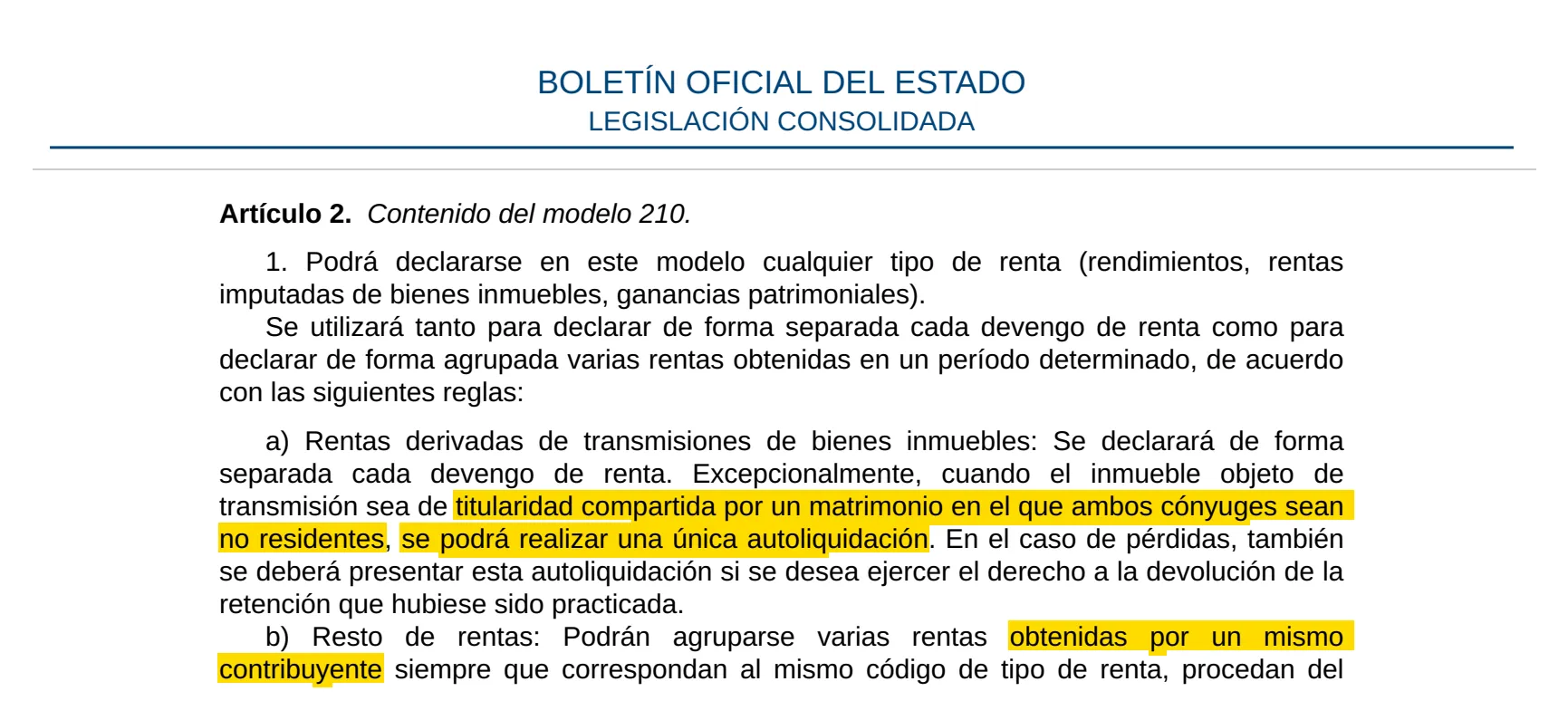
Modelo 210 co-owners each file their own return: a couple who own a home half each, two siblings who inherited it, two friends who bought it together. Each declares their share of the income, at the rate their own residence gives them. One exception: a married couple who are both non-resident can sell on a single return.
By the CasitaTax team · Updated November 9, 2026 · 8 min read
In short
 One return per owner, per home: a couple file two for the home's yearly income, never one together.
- Each declares their share, usually the one on the deed; a home that is common property of a marriage counts half each unless another share is proved.
- Each owner pays at their own rate: 19% in the EU and the EEA, 24% elsewhere, the United Kingdom included.
- The owner is always the person filing; a spouse can submit the other's return with a power of attorney registered with the tax office.
- A sale is the exception: a married couple who are both non-resident may file one joint return.
On this page
Do co-owners file one Modelo 210 or one each?
One each. Spain taxes each non-resident on their own income, and a Modelo 210 belongs to one taxpayer: it can group several incomes of the same owner, never two owners. A couple who own a flat half each therefore file two returns every year, one per person, as our guide to the Modelo 210 deadline counts them.
A married couple who own it together, both living abroad, home not rented out
- Returns for a year
- Two: one per spouse
An unmarried couple, siblings, friends
- Returns for a year
- One per owner
A couple, one living in Spain
- Returns for a year
- One Modelo 210, for the spouse abroad; the other is taxed under Spanish income tax
A married couple, both abroad, selling
- Returns for a year
- One per spouse, or one joint return
A surviving spouse with the usufruct of the whole home, children with the bare ownership
- Returns for a year
- One, for the usufructuary, on a home not rented out
| Who owns the home | Returns for a year |
|---|---|
| A married couple who own it together, both living abroad, home not rented out | Two: one per spouse |
| An unmarried couple, siblings, friends | One per owner |
| A couple, one living in Spain | One Modelo 210, for the spouse abroad; the other is taxed under Spanish income tax |
| A married couple, both abroad, selling | One per spouse, or one joint return |
| A surviving spouse with the usufruct of the whole home, children with the bare ownership | One, for the usufructuary, on a home not rented out |
This guide follows the State's rules. A home in Navarre or the Basque Country falls under their own tax offices, which have their own Modelo 210 and can treat couples differently.
How is the tax split between co-owners?
Each owner is taxed on their share of the income, not on the whole: the tax office treats the income as earned by each owner in proportion to what they own. For a home not rented out, each takes their share of the notional income worked out from the cadastral value, then applies their own rate.
Take our example home: a cadastral value of €120,000, in a town whose cadastral values were revised in or after 2012, so a notional income of 1.1% of it, €1,320.00 for the whole home. Owned half each:
Share
- Owner A
- 50%
- Owner B
- 50%
Notional income declared
- Owner A
- €660.00
- Owner B
- €660.00
Tax, both living in the EU (19%)
- Owner A
- €125.40
- Owner B
- €125.40
Tax if B lives outside the EU and the EEA (24%)
- Owner A
- €125.40
- Owner B
- €158.40
| Owner A | Owner B | |
|---|---|---|
| Share | 50% | 50% |
| Notional income declared | €660.00 | €660.00 |
| Tax, both living in the EU (19%) | €125.40 | €125.40 |
| Tax if B lives outside the EU and the EEA (24%) | €125.40 | €158.40 |
Each return is filled in the same way as a single owner's, with the share applied: box by box in our Modelo 210 form guide. For your own figures, the non-resident tax in Spain simulator asks how many owners there are.
Which share does each owner declare?
The one the law gives them, which is usually the one on the deed (escritura): half each when you bought half each, or a third each when three heirs inherit equal shares. Two rules complete it.
- Common property of a marriage: a home that belongs to both spouses under the rules of their marriage counts half each, unless another share is proved, whichever country's rules they married under, as we read the law. So a home bought during a marriage under shared property can count half each even if only one name is on the deed.
- When ownership isn't proved, the tax office may treat as the owner whoever appears as such in a tax or other public register.
Whether your marriage makes the home common property is a question of civil law, not of Modelo 210: in doubt, the shares on the deed are where to start, and what the tax office sees.
What if you don't live in the same country?
Each owner's return follows where that owner lives. The rate is 19% for residents of the EU, Iceland, Norway and Liechtenstein, 24% for everyone else, the United Kingdom included since Brexit: a couple split between France and London pay two rates on the same home, as the example shows. Under the law, only residents of the EU and the EEA deduct expenses from rent; for owners elsewhere, that rule is now being reviewed by the courts.
If one of you is tax resident in Spain, that spouse isn't a non-resident: their share falls under the Spanish income tax (IRPF), not Modelo 210, and only the other files a Modelo 210.
Can one of you file for both?
Not in your own name. For a home's income, the form requires the owner as the person filing: each return names its own owner, with their own NIE or NIF. What one spouse can do is submit the other's return, with a power of attorney the other registers with the tax office, online with their own Cl@ve or digital certificate; it is still the other's return.
- 1Each owner has a Spanish tax number, an NIE; without one, the predeclaración can give an identification code for the occasion.
- 2Fill in one return per owner, each with their share, online or with the Modelo 210 predeclaración if you have no Spanish digital access.
- 3Pay each return: by direct debit from an account the owner holds, a joint account included as we read the rules, or by transfer from abroad, which anyone may send: see how to pay Modelo 210.
- 4Keep both receipts: each owner has their own proof of filing.
If one spouse's return is forgotten, that return is late, with its own surcharge if it is filed before the tax office asks for it, as our guide to Modelo 210 late filing explains. A missed year for one owner is caught up like any other: see Modelo 210 previous years.
We file your Modelo 210
 Every owner, every year
- You approve before we file
- 100% online
Both returns, one request: with Modelo 210, we file each owner's return from the details of your home and pay each one's tax to the Agencia Tributaria.
What if the home is rented out?
The same rule: each owner declares their share of the rent on their own returns, and, if they live in the EU or the EEA, their share of the expenses. The days the home wasn't rented give each owner a notional income on their share, as for a home left empty.
A return can group the rent of one owner, never that of two: a couple who rent out a flat half each file two sets of rental returns.
What about a sale?
That is the one exception. When a home owned by a married couple who are both non-resident in Spain is sold, the spouses may file a single joint return for the sale. Otherwise, each seller files their own, on their share of the gain.
- Married, both non-resident: you can file one return, marked as joint with the spouse, with each spouse's share and the other's details.
- Unmarried couples, siblings, friends: one return per seller, as we read the rule, which speaks of a marriage only.
- One spouse living in Spain: no joint return; the spouse abroad files alone.
Online, the joint return is signed by one spouse with their digital certificate or Cl@ve; the other, with their own Cl@ve or certificate, first gives them the tax office's power for Modelo 210 ("210P"), which lasts up to five years.
What if one of you holds a usufruct?
For a home not rented out, the holder of the usufruct (usufructo) declares the notional income the owner would have, for the part their usufruct covers; the bare owners don't declare that part. A surviving spouse who holds the usufruct of the whole home files for all of it; when they own half outright and hold the usufruct of the other half only, the same: their own half, and the other half as usufructuary. Children declare any share they own outright, free of usufruct.
What changes on the form from 2027?
Returns filed from January 1, 2027, whatever their tax year, use a new form with a box for the owner's share (Cuota participación) and one for the number of days, for a home not rented out and for rent. On a sale, the joint-return box becomes "joint with spouse" or "individual". The rule itself doesn't change: one return per owner.
How we checked this guide
We read the official texts below and update this guide whenever the rules change. It is general information, not advice on your own situation.
- Real Decreto Legislativo 5/2004, texto refundido de la Ley del IRNR (arts. 5, 8, 15, 24 y 25) — read on November 6, 2026
- Ley 35/2006, del IRPF (arts. 11 y 85) — read on November 6, 2026
- Orden EHA/3316/2010, modelos 210, 211 y 213 (texto consolidado, arts. 2, 3 y 13) — read on November 6, 2026
- Orden HAC/623/2026, de 12 de junio (BOE-A-2026-13573) — read on November 6, 2026
- Agencia Tributaria, Modelo 210: instrucciones — read on November 6, 2026
- Agencia Tributaria, Apoderamiento entre cónyuges para declaraciones conjuntas del modelo 210 — read on November 6, 2026


